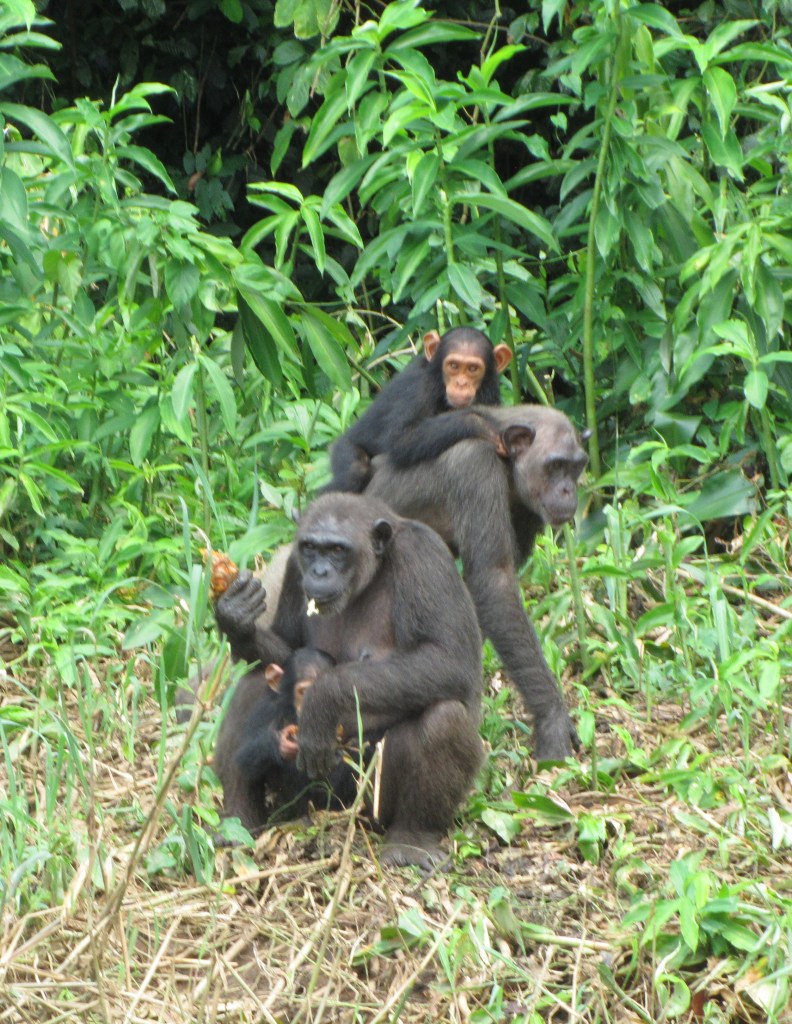
Last week in the Life Scientific on Radio 4, the interviewee spoke of his early career following troops of chimpanzees in Uganda. He was particularly struck by one young male, who was named Jingo. This chimp was not particularly large, but he was fast, and he played a particular role in the hunting parties of the group. As a fast, young, agile male, Jingo’s role was to chase the prey (usually monkeys) through the treetops and, because of his size and speed, he was usually the first to arrive at the kill.
Normal chimp behaviour suggested that at this point Jingo would either start to eat the kill, which would have been a challenge to the dominant males, or make a point of subservience and protect the kill until the dominant males arrived to claim it. Jingo did neither. He stood back and allowed all the chimps, and particularly the younger males and females, to have their fill of the kill before the dominant males finally arrived to find nothing left. The dominant males, the big boys as stated in the interview, were often furious at this turn of events but there was little they could do. Meanwhile Jingo picked up a following among the younger males and females and, while he was never big enough to challenge to big boys directly, ended up leading the troop for many years through what can only be described as careful political manoeuvring.
Apart from giving a really interesting insight into chimpanzee behaviour this story struck a particular chord with me because so much of my own behaviour and activities within the University have followed the path as set out by Jingo.
In almost thirty years of work within a university setting I have always been very conscious of not being able, or willing, to play with the ‘big boys’. I am fundamentally opposed to the macho approaches to management and would not contemplate competing with those who engage in this activity on their own terms. I was significantly bullied while at school and learnt very early on to match aggression and violence with an offer of help and support. I won the bullies over by ignoring their threats and offering to help them in their schoolwork, or otherwise, making myself somewhat essential to them if they were to avoid the humiliation of the school system. In doing that I am fully aware that I probably endorsed their violence and did little to challenge the system itself.
In moving to a university lecturing role bullying once again became very visible, directed at myself on occasion, but more commonly at my female colleagues or others who were less able to defend themselves (or who cared more for the consequences) than I ever did. On only one occasion did a line manager threaten me directly with adverse consequences if I did not co-operate in a culture of bullying. That person did not last long in the job as I found other ways to have them moved on. Taking on particular individuals, however, does not, of itself, challenge the system that from the mid-1990s through to the current environment, has always been dominated by what might be called ‘the big boys’ and increasingly also by the ‘big girls’. And it is always the case that these dominant, and dominating, individuals always seem to end up getting to top jobs and the significant roles within the university.
My policy and practice in this environment is not dissimilar to that of Jingo, and the story of his rise to power, and methods of achieving that power, resonated immediately with my own story.
I am not sure that I would really describe myself as either ‘quick’ or ‘agile’ in any physical sense, but intellectually and particularly politically I have often been able to side step, manipulate and outwit many of those who have competed with me for senior academic roles. I rose through the ranks of academic leadership relatively quickly at Birmingham, taking advantage of restructurings and the uncertainty that these created to position myself in a series of ever more significant roles, ending up as acting PVC and Head of the College of Arts and Law. It was not so much the means by which I was able to achieve that rise (largely a case of being in the right place at the right time) but what I would always do to consolidate each step up that ladder that was significant, and which relates more clearly to Jingo’s narrative.
I used each position, director of learning and teaching or head of department/ school/college, to support and enable others. That has always been my way. It is not necessarily a deliberate policy and to describe this action as a political strategy probably gives it far too much weight. I would always support others, encourage them to develop their skills, fight their corner when I had to, and provide opportunities for growth and development. I have always felt that by encouraging others to flourish things develop and grow within an institution, where bearing down on them, demanding compliance and measuring against an increasing number of KPIs will only diminish and discourage and lead to conformity and stagnation. It has not always been easy, however, to continue that policy within a culture where compliance, micromanagement and KPIs are still the dominant mode of authority.
As with Jingo, sharing the spoils of the hunt, in my case supporting peers and those who I have been responsible for, has always led to tensions with the ‘big boys’ who expected me to play a very different game, and has also led to significant popular support that I have been able to use at times as leverage against the big boys in order to develop my own agenda. I have survived a number of attacks from those above (or more commonly around) me and, by many criteria, I have thrived and carved out a very successful career for myself in university leadership. Having reached a certain point in that career, however, I am not really sure whether the practices and policies that I have followed will now take me any further.
Unlike a troop of chimpanzees, the major difficulty with the university world is that the various ‘troops’ or institutions, are connected, and it is not just a case of rising to the top within a sealed political unit. If the top jobs in the university were handed out on the basis of the wishes of the staff, something perhaps a little more democratic than we currently have, then I could well have been in a good position to retain, or gain, a leadership role above the one that I now have. However, that is not the case. It is always possible for the big boys, or girls, to move between institutions and the macho leader is still (even in these days of EDI and more ‘humane’ management) a preferred candidate. It is not the staff of the institution, the members of the chimpanzee troop, who have to be convinced, it is other ‘big boys’ and ‘big girls’ on Councils and Senior Leadership Teams. They are still, to a very large extent, playing the game of league table performance and management by KPI, something that I have considerable experience of, and an unenviable track record in, but something that ultimately is not in my nature. I still feel like the smaller – albeit more agile, and more politically astute – contender, and I am not at all sure I will ever, now, get that top job where a real difference can be made.
 Martin Stringer Quartet