Listening and Learning?

Another speaker, a local Methodist minister I think, commenting on the recent riots in Northern Ireland following the violent attack by a Somali individual, noted that he had spoken to a fifteen-year-old youth involved in the riots. This youth had apparently told him that he was rioting because ‘they are slitting our throats and nobody is listening to us’. Rioting, the youth suggested, was the only way for people like him – young, working class, white – to be heard. The minister concluded by affirming that it was essential that we do listen to individuals like this young rioter and that their voice is heard, or else we will never address the real issues.

My answer to this is both ‘yes’ and ‘no’. Since the riots I have seen both Ken Loach’s 2023 film, The Old Oak and Russell T. Davies’s Tip Toe on Channel Four television. Both are hard hitting social dramas and both, in their own ways, attempt to give a voice to those, like the young rioter, who are not heard in our society, those who are now voting for Reform, or Restore, or supporting even more radical groups.

Loach sets his drama on the coal fields of Durham and focuses on the impact of a group of Syrian refugees who are bused in to live in an ex-mining village that is already struggling with the destruction of their livelihood, identity and community. It is older men, ex-labour voters no doubt, who remember the community and the pride of the mining past but who now have nothing, and resent the arrival of new people who appear to be given preferential treatment while they are ignored and rejected by the state. The film is ultimately positive, showing how eating together, sharing stories of suffering and mutual aid can lead to renewal and a revitalised sense of community.

Tip Toe is much, much bleaker. The focus here is sexuality, and more tangentially trans identities. The series notes how hard-won freedoms and recognition within the queer community are being lost and how new (old?) prejudices are being given permission to be expressed in public. The protagonist, if that is the right word, is an electrician who has little work, has been banned from building sites for bullying, and who is trying to hold together his own, masculine, identity within his family (with two late teenage sons) when all that makes up that identity has been taken from him, not least, in his eyes, by those who appear to be benefiting from the current EDI culture, in this case the gay community personified by his neighbour, a successful club owner in Manchester’s gay village. I will not say more about the plot so as not to give away any spoilers. Suffice it to say that this does not follow Leach towards a positive outcome.

Both the film and the television series are excellent at giving voice to those, like the young rioter in the Northern Ireland, who have undoubtedly been silenced in recent years and who are now looking to right wing causes to give then permission to voice their frustration and hurt. It is not, therefore, that rioting is the only way that such people, primarily men, can be heard. However, neither Loach nor Davis are entirely sympathetic to those in this position, at least not politically, and in both cases the voice of the frustrated, disenfranchised, silenced men is portrayed negatively, as something that can only lead to violence, something that needs to be overcome.

Listening, therefore, is only ever half of the issue. Yes, we need to listen, to recognise this discourse, the men and women out there who have been overlooked, left behind, silenced, by the dominant discourses of the last twenty years or more. There are important things that need to be said and to be heard. However, we need also to recognise that simply giving voice to such groups, and doing nothing more, will only ever lead to negative outcomes.

My first reaction to hearing the Methodist minister on the radio was to say ‘yes’ let’s listen, but we also need to help that young man to see how negative his view is, and how wrong it is. ‘They’, as a group, are not murdering his people in the street. This was the act of a lone, probably damaged, individual. Not all immigrants, or all black people, or all queer people, or whoever it is, can be lumped together as ‘the enemy’. There is an educational task as well as a listening task.

Part of me, however, wants to be wary of such a response. Am I not being patronising, all very white liberal, in saying that we must educate, put right, such individuals? Perhaps I am, but that does not necessarily mean I am wrong. What is the alternative. Of course we must also rebalance the structures. In both Loach and Davies, the underlying issue is economic; the lack of work, the inability to claim the traditional white working-class male identity. We might question the basis of that identity, and the (toxic?) masculinities that underpin it, but we must also see that society needs to offer work and hope to such individuals as well. These things are never easy, but this is, perhaps, the most critical ( and dangerous) issue facing society today. Let’s hope a new Prime Minister sees this and can begin to address some of the underlying issues.


What do we need Government/Community for?

I heard something on the radio over the weekend that got me thinking. A woman from Northern Ireland was speaking about the network of people who, connected by WhatsApp, had rescued and supported numerous immigrant families during the recent riots. It was difficult listening. It was also inspiring, seeing what is possible when social media is used positively for the benefit of others. However, when the woman said that the community was only doing what the government should have been doing, then I began to ask myself a series of questions, primarily about the place of community and its relation to government:-

Where is Community?

The inspiring element of the report from Northern Ireland came from the fact that this was ordinary people, linked together by WhatsApp, who had acted to help those in trouble. It was community action. However, community is something that appears to be entirely lacking in so many parts of our country. Ironically, it may be stronger in Northern Ireland than in many other places, but I would not guarantee that.

Since COVID most of the houses down our little street have been sold and new families have moved in. As I walk the dogs past the various houses then I have noticed that every one of them has either heavy wooden shutters pulled to across the windows or closed curtains. We used to have a thriving little community down this street, with Christmas gatherings and summer parties. Now I nod and say hello if I happen to see a neighbour moving rapidly from their car to their house, and most of the kids appear to know the dogs, but there is no conversation, no community, and I am sure that we are not alone.

Perhaps, you might ask, why have I not got out there and created a community, organised the gatherings, invited neighbours to parties? A good question, but I am not really a community person and never have been. I have always associated community with exclusion and would see community more easily among the rioters in Northern Ireland, or those who share their ideology, than among those who support the excluded. It sits rather oddly with me, therefore, to be advocating for community.

Can Government Create Community?

I remember all too well the Blair government’s attempts to coopt the idea of community. When I was working on church-community relations in Manchester then everything the government did was labelled ‘community’. There was community policing, community health care, care in the community and so on. This was never real community and, as I argued at the time, this was an attempt by government to save money by claiming a narrative that still, in the 1990s, had positive associations in the public mind, and using it to push people away from government services.

The Cameron government, some ten or twenty years later, talked about the Big Society and advocated communities working alongside government to tackle some of the unmanageable problems within society. I am sure David Cameron, like Tony Blair, was working with the best of intentions and believed, explicitly, in community and government working in partnership. The fact that both ended up looking like government pushing responsibility onto the community has, I would suggest, done lasting damage.

Who is Responsible?

We now have a situation where community has declined yet further, both through deliberate government action, but also through the rise of social media, the fall out of COVID, and through many other factors. We now turn to government and expect them to answer all our problems, look after the weak, guarantee our safety, or whatever it is. Many of these roles have never been those of government at the local level, and government cannot do these things without the implicit, if not explicit, support of the community. If nothing else, we do not give the government enough money by way of taxes to do this, and, I would say, we never will. It is, I would strongly argue, not their job!

In days gone by, every individual had responsibility for the members of their wider family, particularly the children, the elderly and the vulnerable: ‘It takes a village to raise a child’. Every household also had a responsibility for those who came to live in their neighbourhood, supporting those who were down on their luck because at some point in the future we might need their support in return: ‘love thy neighbour’, or whatever might be the equivalent in other religious discourses. Is this simply romanticism? I am not sure. Of course, many people failed both their relatives and their neighbours, but overall, on average, statistically, the support was their and was visible. Now it is not.

Who, then, is responsible? Do we condemn the government whenever others suffer, while refusing to let them raise our taxes? Do we deny any personal responsibility, sticking to our own, social media based, communities of interest (bubbles/echo chambers)? Can we see a way of nudging the pendulum back towards community? Or must we now wait for society to finally collapse before we can all begin again, building new communities because of absolute necessity? I am not sure I am very optimistic on this one…

Habitus and Discourse

This is the second of my blogs on Bourdieu and aims to try and make sense of the concept of habitus. There has been an incredible amount written about habitus, and the general view is that it can pretty much mean whatever you want it to mean in any specific context. That is probably unfair, but the range of meanings and uses offered in the literature does tend to suggest that it is not too far from the truth.

My own thinking has been reignited by reading In Other Words, a series of previously published interviews and essays brought together in 1987. This is not one of Bourdieu’s better-known texts. However, it does set out a clearer sense of what Bourdieu is trying to get at in relation to habitus than most of the other writing that I have looked at, probably because the interviewers are consistently asking him for clarity, or asking him to compare the concept with other, better known, ideas.

What this led me to reflect on, however, is the relationship between Bourdieu’s use of habitus and field in relation to Foucault’s ideas of discourse and discipline. I am not a hundred per cent sure of the dialogue between Foucault and Bourdieu, it is not explicit in many of the texts, and I assume there was some level of suspicion between them. However, the ideas, while working in different registers, look to be very similar, at least in practice, and that similarity works for my own purposes (which is the main point!).

I have probably simplified Foucault, but my understanding, from The Archaeology of Knowledge, is that discourse is the body of language within a specific discipline, not just words but more explicitly ways of talking, and therefore ways of thinking. The most important factor is that the discourse limits the kind of language, or thought, that is possible within that discipline. Foucault uses medicine as his example. There are ways of talking (jargon, concept, assumptions, structures) that are distinctive to modern scientific medicine and, more importantly, things that cannot be said. I always use the example of a doctor who, on being told that you have a headache, asks you to sacrifice a chicken and sprinkle the blood to the four corners of the room. This is not within the modern scientific discourse of medicine. Things do change over time, however, as the boundaries of the discourse are always being tested and pushed, and so the nature of the discourse is always historically contingent, but it still has its limits and its own rules, or, we might say, its specific grammar.

Foucault does recognise that other factors, beyond the use of words and sentences can be part of the discourse. Images, setting, clothes, attitudes etc. etc. can all form part of the discourse of modern scientific medicine and work in the same way as language, with limits set and then pushed against etc. However, Bourdieu’s concept of habitus appears, in some ways, to fill this space in a different way. He is talking about behaviours, and more specifically about the embodiment of behaviours in a way that is spontaneous, essentially unthought within the specific context. He talks about habitus in relation to field, however, in much the same way as Foucault talks about discourse in relation to discipline. Within a particular field a specific habitus – a way of behaving, or using the body, a mode of being – is expected and normalised. Again, there is some expectation of challenging boundaries, and Bourdieu’s concept of strategies does recognise that individuals have a choice, they are choosing to play the game, to maintain the habitus of a specific field or to switch fields, or whatever.

One of the reasons this is important to me is that I have always unconsciously thought of habitus as ingrained and associated with ‘culture’ and therefore related to society. The great thing about Foucault’s discourses is that we can all work within a range of discourses dependent on the discipline we are engaged with, and there is reference here to Gerd Baumann’s dominant and demotic discourses and his concept of dual (or multi-) discursive competence. Relating habitus to discourse, and field to discipline, also allows for multiple contexts, and the need, or ability, to switch between habituses (is that the plural?) as we move between, or across, fields. This is important as I work from an assumption that all societies, even the simplest, are made up of multiple discourses, layers, fields or whatever you might want to call them. If we are constantly called to move between fields, to shift our habitus, as also our discourse, then this makes sense of the world I am trying to describe.

Finally, a footnote. At a recent event I was talking to somebody who mentioned the way different societies construct portraits, particularly comparing the Western perspective focusing on the individual and native Australian perspectives focusing on the community. We do see things differently, or perhaps more accurately, our assumptions and preconceptions mean that we do express our ‘seeing’ in different ways. What this suggests to me, therefore, if discourse is to discipline (in terms of language) as habitus is to field (in terms of bodily behaviours), is that there must also be an equivalent in terms of visualisation, what is acceptable in a specific visual field/discourse? And if that is the case, then could we also say the same for other modes of behaviour/being? Where might this end? It may, however, only be necessary to go back to Foucault, for whom, in my presentation, ‘discourse’ covers the visual, images, behaviours, settings etc. etc. There is far more to think through here.

Globalising Tate Modern

Having a conference in London with an early start on the 21 April I travelled down the day before and thought that I would catch a few exhibitions that I had noted on the internet.

My travels started at the National Portrait Gallery. For reasons that I was not entirely sure about, the National Portrait Gallery had never been high on my list of galleries to visit. I have been passed it many times but have no clear recollections of ever having been in. There were two exhibitions, one of Lucien Freud’s work and one of a photographer who, among other things, had created images of queer London. I had not checked the prices of these exhibitions and was somewhat shocked to find they were close on £20 each. It is probably some time since I attended an exhibition at one of the London galleries so I have not noticed the rise in prices…

However, it was the experience of wandering around the gallery that ultimately unnerved me and meant that I did not stay long. The emphasis, even in the Tudor galleries, appeared to be entirely on celebrity, the person of the sitter rather than the technique of interests of the artists. I have no real interest in celebrity, although there was an excellent photograph of Elton John, David Furnish and their two teenage boys in some kind of library that was surprisingly arresting. The other sensation I was left with was being followed around each gallery by a host of eyes constantly looking at me from the portraits. It all made me feel very uncomfortable and I left without visiting the exhibitions.

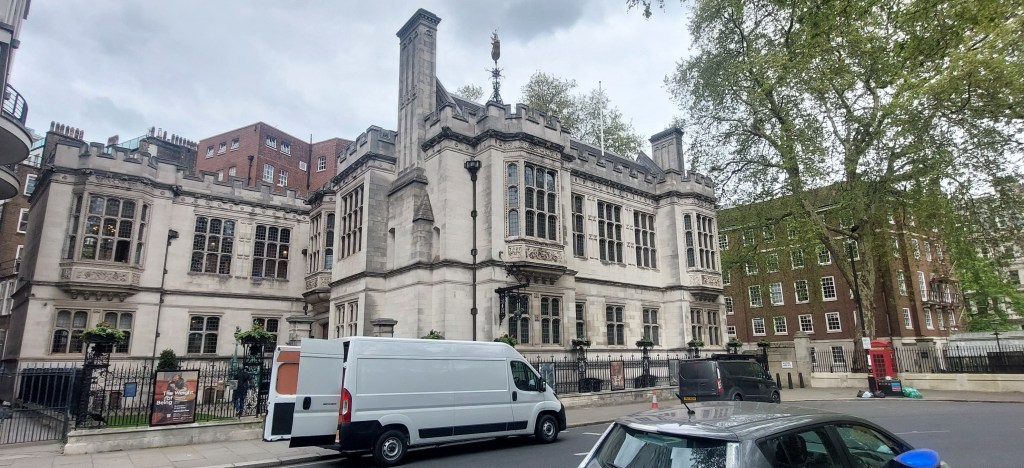
My second stop was 2 Temple Place, an eccentric mock Tudor pile by the river built by the American financier William Waldorf Astor. There was an exhibition of art inspired by issues relating to mental health advertised but I could not find a way in and the main door appeared locked. My walking, from there to the Tait and then north to Euston and my hotel, took me around the various Temples or law courts. This is an area that I do not know at all well and must explore further at some time, especially as I noted a pamphlet recently in one of David’s buys on the Temples that no longer exist.

The core of my gallery visiting therefore was Tate Modern. The main draw was an exhibition of Nigerian Modernism, art from Nigeria just before and after independence. It was well worth the entrance fee (also £20). I was probably most struck by a room, early in the exhibition, devoted entirely to the work of Ben Enwonwu, who straddled the time of independence and who was educated and trained in the UK. He clearly gained quite a following in his own lifetime and a series of wooden sculpture made for the Daily Mirror building in the centre of the space were captivating. However, it was the way in which he used the Western obsession with masks, both in museum displays and through references to Nigerian cultures, that I found most fascinating. There was a reference back to Picasso, but also a use of imagery, style and the use of the human form that I knew and had picked up on in later African art.

Much of the rest of the exhibition dealt with various schools of Nigerian artists. Some of it referenced back to European styles and trends of the time, some was stereotypically ‘African’, but much of it was highly original. I think one of things that struck me was the commonality. This also linked to some of the art that I associate with my father’s time in Tanzania (also in the years just before independence) and his attempts to develop art among his students at the teacher training college, and also the contemporary Makonde arts that I also know quite well. There was, clearly, some kind of pan-African style emerging, that related to a pan-African political positioning, and that has no doubt been noted and written about by others.

It was in looking at the main, free, exhibition within the Tate, however, that I noted the new emphasis on the global, touching on, but perhaps not quite expressing, decolonisation. The arrangement was more on art and society, or art and form, but the examples came from across the world and demonstrated a really interesting juxtaposition of styles, influences and techniques. There was a common thread on responses to war, primarily civil war, and suffering and another thread around queer issues. This was a thrilling series of rooms and some amazing and captivating images. One that will stay with me came from a Pakistani artist depicting a naked youth at a dinner table, with an indifferent father and the families’ women in shadows, while behind him he was bombarded with, and overwhelmed by, the products of television, social media, Islam and politics. It was a powerful representation of the pressures of queer youth in a Muslim culture.

For all the global references, artists and imagery, however, the one space that had the most impact on me remained a room, right at the heart of the building, containing a series of Rothko paintings, originally created for a restaurant in New York. The room was dimly lit and the space was expansive, but still immersive. There was one other person, (on her phone throughout) but I found myself in an entirely other world, overwhelmed, and drawn into, the colours, the images, the paintings and the space that was created.

The Cosmic Incarnation

I had a student, some years ago now, who wanted to do a study of the place of green issues in the Anglican liturgical texts. I am sure he expected to find an absence. He soon discovered, however, that because the liturgy had emerged within a largely agricultural society, one that was far closer to nature than we are now, issues associated with nature and the cycle of the year etc. were current in many different elements of the rite. This should not have come as a surprise, but it is also something that I have not really thought about or reflected on as much as perhaps I should.

I have never been overly concerned with climate change and the destruction of biodiversity etc. My priority has always been focused more closely on social justice and human inequality, although I do recognise that the two are intimately related.

When I have thought about writing a three-volume work on the incarnation it is the human, and the social that I have always assumed would be the core of the text. I have always recognised, however, that I needed to start with hierophony, the recognition of God in, and through, the world before speaking of God’s intervention in that world. I had thought that I would start there primarily to dismiss that strand of thinking only to move on to more human, more incarnational, topics.

Going through the liturgy in the traditional Latin rite over the last few days, however, and concentrating particularly on the text (not something I have normally done – not having to concentrate on the words being one of the reasons why the Latin rite appeals) I have been struck by just how much the natural world, and the cosmic, plays within that text.

There is a focus, for example, on materiality – on wood, on oil, on water, on fire, on beeswax and so on – and a recognition of, or more accurately a calling for, the indwelling of the Spirit within the material objects. The great blessings – of oil on Maundy Thursday, or of the fire, the candle and the water on Holy Saturday – places the material substances at the core of the liturgy. And throughout Good Friday there is an emphasis on wood, in all its forms, and more specifically the tree on which Our Saviour hung.

What was more significant, however, in the Holy Saturday liturgy, was the cosmic scale of the events that are unfolding. This is seen specifically in the Exultet. With the repeated statement that ‘this is the night’, and similar statements of repetition and coincidentality throughout the text. The readings begin with creation and the events of the cross, and the resurrection, are consistently placed within the cosmic realm, way beyond the events of those few days in Palestine over two thousand years ago.

Time is central here. We are often told that Christianity introduced a linear time, as opposed to cyclic time of the earlier religions. Eliade places a great deal of emphasis on the condensation of time, such that in ritual the time of now is merged with the time of origins. This is exactly what the Holy Saturday liturgy is doing, freezing time rather than introducing linear time.

Every Mass makes the time of the present and the time of the past, the crucifixion and the last supper, coterminous. The Holy Saturday liturgy takes that out and brings the time of creation, the time of the crucifixion/resurrection, the time of so many other events, and the time of the current liturgy into a moment of stasis, where all time is condensed into one, no past and no future, alpha and omega become one. This is not linear time, this is time as perceived from God’s perspective, where all becomes one, eternity in the blinking of an eye.

Over this weekend four astronauts are also travelling beyond the orbit of the earth and circling around the far side of the moon. They have sent back incredible, although no longer entirely new, images of the earth from space, that wonderful jewel of a planet in the darkness of infinity. What makes that place so special? Why is that place singled out for the incarnation of our God?

It is that question, along with the reflections on time that come from the Holy Saturday liturgy, that lead me now to think that the first part of my trilogy on the incarnation must be more positive, not just a dismissal of hierophony, but a celebration of the cosmic incarnation.

There is far more work to do here, but certainly something to think about…

Constructing and Controlling Common Sense

This is the first of what I hope will be a series of blogs that comes from my reading of Pierre Bourdieu. Others will deal more explicitly with some of his key themes. In this first blog, however, I want to address what he offers as a kind of throw away remark. A remark that I think is of fundamental importance in our social media saturated world. Bourdieu suggests that whoever controls common sense controls the way society talks about itself and about the world around it.

Common sense is not something that I have ever really reflected on. There is a series of arguments in the anthropology of religion that I would refer to under the heading of ‘religion as common sense’. Clifford Geertz is the figure I have most regularly associated with this view in my undergraduate lectures. It is Geertz’s suggestion that religion is simply a mode of thought, the basic, unspoken and unquestioned way of thinking within a specific society, and hence ‘common sense’ for that society, that is the basic principle behind this view.

My partner also regularly tells me that something or other that I have failed to do correctly, whatever it might be, is ‘common sense’. The fact that he and I disagree on how to do the task in hand or, more frequently, that my dyslexia means that I simply cannot remember how to do it, shows that it probably is not as ‘common’ in terms of sense as he assumes.

However, I have never really thought about common sense as something that is constructed or controlled. It takes very little thought, however, to recognise that this is the case. It is very rare that we see ‘common sense’ change in real time. Looking back on my lifetime, however, I can see many obvious changes (even if we ignore the impact of technology on what is ‘common’ sense).

In the 1970s and 80s it was ‘common sense’ that gay men were sexually interested in boys and latent paedophiles. Everybody thought that they knew that to be true, very few people seriously questioned it, and Section 28 was based on that principle. It took considerable effort, and ten, twenty, perhaps even thirty years to change this ‘common sense’ position. Today it is ‘common sense’ that gay people will want to settle down, get married and have kids – something that I still find rather problematic.

In recent years, however, I have seen common sense change much more rapidly, either because of sustained argument or, more frequently, due to a draconian insistence that it is the case, even when every argument argues against it. Trump is a master of stating things so loudly and so insistently that a surprising number of others come to believe that he is ‘simply stating common sense’ – what we all agree and know to be ‘true’(??).

The most explicit space where I have seen this change in action is in the move from the ‘common sense’ position that we must respect whatever identity any person chooses to adopt for themselves, to the ‘common sense’ position that women are biological women and trans women are obviously not women. This is partly a case of critical feminists simply stating, over and over again, their position, primarily by insistently asking the question ‘what is a woman’, but it also depends on the structure of the statement ‘women are women’ which appears, logically and structurally, to be ‘common sense’ and has, most recently, been defined in law and so must be ‘common sense’.

Whoever controls common sense, therefore, to go back to Bourdieu, controls society. What matters, therefore, is to set the parameters for what is, and what is not, common sense. One change, in recent years, is that certain politicians and social commentators, have deliberately begun to put this principle into practice. In doing so they have recognised, as I have suggested, that the best way of doing this is to state the case, over and over again and as loudly as possible, rather than trying to argue their case – something that those of us who have been trying to change social values over many years end up doing primarily because we do not want to offend!

 Common sense is also related to my theory of situational belief. It is formed of a series of statements that we might call ‘belief statements’. Such statements can be used to make sense of specific situations, but they need not be coherent or consistent across different situations. Another strategy, therefore, is to take key statements that are already widely accepted by the speaker’s opponents and to build new statements on these foundations, making it difficult for the opponents to reject the new statements without also rejecting the shared common position as reflected in the widely accepted statements, the ‘common sense’, that is recognised as being shared.

The statement that women are suffering increasing levels of sexual abuse, for example, is a statement of common sense that is noted across the political spectrum, but that has been most explicitly stated in recent decades among those on the left. Those of the right, however, have recognised this and have appropriated this ‘common sense’ statement by adding to it the statements that the most significant perpetrators of sexual violence on women are trans women and/or immigrants.

The original statement, condemnation of sexual violence against women, should bring us all together (although the identification of men, as a category, as the perpetrator and so the ‘enemy’, and the impact of this on boys, is another discussion). The new elements then begin to divide and are open to challenge factually. By creating these views as ‘common sense’, however, it allows those on the right to endorse certain policies that many of find morally unacceptable.

Recognising that the right has become incredibly good at controlling, managing and even creating ‘common sense’, explains, in part, the power that this gives them across society. What Bourdieu does not tell us, at least at that part of his argument, however, is how we challenge this, or perhaps how we set about creating an alternative ‘common sense’. Or perhaps it is the case that to challenge the construction of ‘common sense’ leads to the collapse of the whole structure of ‘sense’ as those on the right would like us to believe? 

The Idea of a Twenty-First Century (Catholic Heritage) University: Part 3, The New Dark Ages

The New Dark Ages

Over the weekend, I read a review of Nigel Biggar’s latest book, The New Dark Ages. Biggar is Professor of Theology at Oxford who came to prominence recently because his earlier book on Colonialism was ‘cancelled’ by Bloomsbury before being taken up by William Collins and becoming a best seller. The current book is wide ranging, but, in part it addresses the question of free speech in universities, advocating a ‘liberal’ approach that Biggar claims to be meritocratic, race blind and sex blind, what he might want to call ‘scientific’.

Biggar suggests that universities should reinstate a series of traditional virtues including ‘temperance (showing emotional restraint), respect (holding fast to the idea that your opponents act in good faith), carefulness (being accurate in representing others), charity (taking the strongest versions of opponents’ arguments), humility (knowing that we all make mistakes), and docility or teachableness (assuming that we always have more to learn)’. These are all principles that both Newman, and I, would heartily endorse.

The reviewer, however, from the Telegraph, kept stating that Biggar was only confirming ‘common sense’. Pierre Bourdieu, among others, has noted that those who control ‘common sense’ control the thinking of society, and we have seen that very clearly in recent years from Brexit, through Trump, to Reform.

When Newman talks about theological truth as ‘inspired’, we can, perhaps, also think that this kind of truth, the moral or ethical truth, is simply given, revealed in a clear and unambiguous fashion, what we might think of as ‘common theological sense’. Newman however, like all those identified as Doctors of the Church, is abundantly clear that there is nothing common, or uncontested, about revealed truth. Theological reasoning, critical reflection and a constant questioning in the light of changing society, is difficult, it takes years to perfect, and is at the core of Newman’s theological approach.

The pursuit of moral truth is not easy, it is no less critical and robust than scientific truth, but it cannot be ignored, marginalised or treated as an optional extra in the work of the university.

It is not only in our academic work that we need to draw on theological truth. When I was asked to revise the EDI strategy at Birmingham University, some ten years ago now, I was clear that we needed to develop a strategy that took account of all the protected characteristics. I know only too well, from my own experience, how the different characteristics can be played off against each other, with religion, for example, often taking a secondary place to sexuality.

The current debate about trans rights and sex or gender is another example of the attempt to pitch one characteristic against another in an apparently zero-sum game. Beginning to think through, reflect upon, challenge, and ultimately argue for, a coherent strategy of inclusion that enables respect for all individuals is far from easy.

Theories of intersectionality go some way to recognise the overlaps between the different characteristics, but they are not focused on developing an approach where all forms of oppression, marginalisation and suffering are given equal recognition. Simply claiming that we are being meritocratic, race blind, sex blind, or blind to any other characteristic, is also no answer to this challenge.

Just because such thinking is not easy, however, it does not mean that we, as universities, should not be seeking the sociological, philosophical, moral, or even theological, truths that make this possible. We will need to draw on all those in our institutions who are steeped in these disciplines to achieve this, and doing so is perhaps one of the most urgent tasks of the twenty first century (Catholic heritage) university.

The Opiniated University

Another recent book addressing the contemporary crisis in Higher Education is Brian Soucek’s Opinionated University. Soucek is speaking to an American audience, and American universities are perhaps facing a somewhat different and perhaps more existential challenges than ourselves. There is a strong call, in America, for universities to be neutral on political and other issues, if only for their own survival.

Soucek states that this call for neutrality is missing a significant point. All universities, he argues, by their very nature, express opinions. In our research we reach, and express, opinions (hopefully well-founded opinions). More importantly, for Soucek, each time we assess an assignment from students we are expressing an opinion, that this work is worth a first, a 2:1 or whatever it might be. We cannot, as universities, get away from expressing opinions and, as such, we are really rather good at it, or at least very experienced at doing so. Why should we then remain neutral in some areas, Soucek asks, and not in others?

I have been speaking recently to colleagues in the Northeast, Newcastle, Sunderland, Durham, who find themselves in areas governed by Reform led councils and recently elected Reform party mayors. They are already finding themselves being pressured, very indirectly and very subtly, to abandon certain positions, particularly around EDI, or to question their international strategies. Students from minority backgrounds are raising their concerns with the chaplains among others. Councils are already putting in place actions to remove ‘city of sanctuary’ status from their areas.

We face local elections here in Birmingham in May. Like the rest of the country these elections are being watched very carefully. At last week’s rally in the city, Nigel Farage claimed that Reform would win a landslide in Birmingham. A local priest, in an inner urban area on the other side of the city, sees the council being split evenly between Reform and pro-Gaza independents. Whatever we think of their politics, neither group has any significant experience of running a city such as Birmingham.

As with the false dichotomy between trans rights and women’s rights, we are also being pushed, by public discourse, and increasingly by the Office for Students, to make a false distinction between freedom of speech, or academic freedom, and inclusion. These are false dichotomies and suggest a particular way of thinking, which, as with my comments on equalities above, we should aim to challenge and to do the critical philosophical, ethical and theological thinking to transcend.

We would all, here at Birmingham Newman University, recognise the centrality of social justice to Catholic thinking and its importance within the wider theological project. As Catholic heritage universities, therefore, we also need to be cognisant of this tradition and embed the search for theological truth both within our practices as universities, in our academic work with, and alongside, our staff and our students, and in our public discourses.

Summary

In summarising what I have tried to address this morning, therefore, I would highlight three points that I have learnt from reading Cardinal Newman’s Idea of a University:

First, the university is the totality of its people, its academic staff, its professional staff and its students. It is wrong to see any one of these as distinct, or more relevant, than the others. Our teaching, our research, our public engagement are all part of the shared responsibility of the community as whole. We might also want to include in this our Council, our alumni and our partners in industry, civil society and the community around us. This is what the ‘university’ of the twenty-first century must be seen as, and all our activities must be fully inclusive of the whole of that community.

Second, we must recognise the interconnection and mutual interdependence of scientific and theological, or moral, truths. One without the other is defective and open to falsehood. For this reason, and not just because of the contribution of humanities and creative studies students to the economy, we must always argue the case for a balance between science, technology, humanities and the creative arts within our institutions.

Third, we are living in dangerous times. There are those who would seek to undermine, if not to destroy, the idea of the university as set out by Newman and by many others over the last hundred and fifty years. Our position, particularly as Catholic heritage universities, is to stand up for that tradition, to undertake the difficult and critical thinking necessary to make our case. Never resorting to simplistic essentialism or to simplistic relativism. This may not always be easy, but, with the vision of St John Henry Newman to lead us, and the confidence of our Catholic faith, I believe that we can stand firm and position ourselves to lead the fight for the relevance of the university into the second quarter of the twenty-first century, and for the next hundred and fifty years.

The Idea of a Twenty-First Century (Catholic Heritage) University: Part 2, Truth(s)

Truth(s)

This takes me to the core of Newman’s argument, particularly in the lectures he delivered to the university in Dublin, the first five sections of the book. Here Newman is keen to emphasise the place of Catholic theology as central to his understanding of what a university should be. More accurately, however, and given the audience that Newman is addressing, Newman is arguing for the importance of studying science and other emerging disciplines alongside Catholic theology.

For Newman, both theology and science seek after truth. However, the truth that they are seeking is different, complementary and, in Newman’s eyes, they are both necessary to a complete understanding of the world.

Science is rooted in a truth that is based on empirical observation and the experimental method. It aims to tell us about the material world and enables us to engage with and develop technologies that allow us to solve the problems faced by this world.

Theology, for Newman, is based on revealed truth. It aims to answer very different questions, about what ought to happen, how to behave, and more specifically about the nature and value of the human person, and the created world, in the eyes of the Creator. This cannot be discovered through experiment or by any amount of scientific enquiry, but science, in Newman’s view, cannot progress without this other, revealed, truth.

Today, we are consistently being told that we must look to the evidence, that science, technology, engineering and mathematics, or medicine are the basis of economic advancement, and that they should be prioritised in our universities. Newman, perhaps, had to argue for a greater place for science in the universities (especially the faith-based universities of his own day). We are looking to a time when science is all, and ‘truth’ is equated with experimental, empirical, truth. But, as Newman would clearly appreciate, ‘truth’ is never neutral.

Truth and Untruth

I am currently writing a book on decolonisation, more specifically on the way anthropologists, art historians, tour companies and popular discourses have used the idea of the Dogon people of West Africa. The academic discourse began in the 1930s among French anthropologists. This was a very active time for intellectuals and artists within the French capital. Core to much of that debate, however, and particularly to the development of ethnology, was what we have come to know as ‘scientific racism’.

From the middle of the nineteenth century work had been underway to discover a scientific basis for racial difference, whether through the measuring of skulls, other physical features or, when that failed, of intelligence. This was an empirical science, rooted in measurements and experimentation, but also in colonialism, much of it was utterly demeaning to those on whom the measurements and experiments were inflicted.

The ‘science’ of race would have sat squarely in Newman’s field of scientific ‘truth’ but it led, among other things, to the horrors of the Holocaust. We know only too well that so-called scientific truths can be partial, destructive and morally false. Scientific truth, in this sense, cannot stand without some reference to Newman’s other truth, the theological, or we might say ‘moral’, ‘ethical’ or ‘social’, truth.

One reasons for my interest in the Dogon people is that I collect art that has been created by these people. On my shelf I have a mask, a black monkey mask. There are many truths that can be related to this mask.

We can enquire about its manufacture and use among the Dogon, about the symbolism and the stories that surround the black monkey of which it is a representation. We can also ask about how it was acquired by dealers, removed from the Bandiagara cliffs in Africa to Paris or to Brussels, exhibited, perhaps stored for a time in the collection of a museum, returned to the market and bought by myself. Each step on this journey raises difficult ethical questions and subjects the mask to a range of meanings and associations that are not always easy to identify or comfortable to confront.

For all these different truths, however, both scientific and ethical, there are certain statements about this mask that are clearly untrue. It is not, as some have claimed, the representation of a helmet worn by visitors to our planet from Alfa Centauri many millennia ago and preserved as a collective memory by esoteric priests on the isolated cliffs where the Dogon live.

We may, following the post-modern turn, want to talk of multiple truths, of different kinds of truth. We may also hear it said that any truth is possible, my truth, your truth, false news, deep fakes. In this context Newman’s emphasis on truth, or on the different bases for truth, becomes ever more important. We need to be very clear when we are talking about truth and when we talk about falsehood, or untruth and that is also part of the purpose of the university.

The Idea of a Twenty-First Century (Catholic Heritage) University: Part 1, Community

I gave a paper at an event at Birmingham Newman University to celebrate the recognition of St John Henry Newman as Doctor of the Church. This is the text, in three parts:

Summary

In summarising what I have tried to address this morning, I would highlight three points that I have learnt from reading Cardinal Newman’s Idea of a University:

First, the university is the totality of its people, its academic staff, its professional staff and its students. It is wrong to see any one of these as distinct, or more relevant, than the others. Our teaching, our research, our public engagement are all part of the shared responsibility of the community as whole. We might also want to include in this our Council, our alumni and our partners in industry, civil society and the community around us. This is what the ‘university’ of the twenty-first century must be seen as, and all our activities must be fully inclusive of the whole of that community.

Second, we must recognise the interconnection and mutual interdependence of scientific and theological, or moral, truths. One without the other is defective and open to falsehood. For this reason, and not just because of the contribution of humanities and creative studies students to the economy, we must always argue the case for a balance between science, technology, humanities and the creative arts within our institutions.

Third, we are living in dangerous times. There are those who would seek to undermine, if not to destroy, the idea of the university as set out by Newman and by many others over the last hundred and fifty years. Our position, particularly as Catholic heritage universities, is to stand up for that tradition, to undertake the difficult and critical thinking necessary to make our case. Never resorting to simplistic essentialism or to simplistic relativism. This may not always be easy, but, with the vision of St John Henry Newman to lead us, and the confidence of our Catholic faith, I believe that we can stand firm and position ourselves to lead the fight for the relevance of the university into the second quarter of the twenty-first century, and for the next hundred and fifty years.

Part 1: Community

St John Henry Newman

St John Henry Newman’s The Idea of a University is probably the best known, and most widely quoted, books on what it is to be a university, although it was originally published over a hundred and fifty years ago in the middle of the nineteenth century. I was immediately struck, however, when I first read it, just how relevant the text sounds all these years later. Given everything that has happened over this time, that may sound a little strange. Have universities really not changed all that much in the last hundred and fifty years? Perhaps, but it may also be because Newman was onto something.

Newman’s book has been particularly influential in the States. Here in the UK, it is noted more as an historical oddity. This may have something to do with its age, but it is also related to the book’s very specifically Catholic, and less obviously, Irish context. Universities in the States tend to be less embarrassed by this, but even in the States the Catholic element has been largely ignored.

In the UK it may be thought that we do not have a strong tradition of faith-based universities. However, up till the nineteenth century the Anglican foundation of Oxford and Cambridge, and their position as ‘the establishment’, was taken for granted. At the time Newman was writing, in the mid nineteenth century there were challenges to this Anglican dominance with universities such as Edinburgh and, in a few more years, Birmingham and the other big civic universities, establishing a more specifically ‘secular’ stance over and against the Anglican establishment.

Newman specifically addresses the debate, that was occurring as he wrote, between the Universities of Oxford and Edinburgh. This was not, however, an argument about faith. It was an argument about the purpose of the university. Oxford claimed to place research and the development of knowledge at the core of their mission while the founders of Edinburgh University saw it as serving the needs of the local economy and providing the skilled workforce required to serve that economy. Newman, given his background, came down firmly on the side of Oxford. He did not argue for the economic value of the university.

Many of our current faith-based universities, those in the Cathedrals group, and including Birmingham Newman University, had their origins in the training of professionals to serve in education and in health. This is something that is still core to our own vision and strategy, but not something that Newman himself might have seen as the purpose of the university.

Community

Before looking at Newman’s argument in more detail, however, it is perhaps worth noting the context in which the lectures on which the book is based were originally given. Newman had recently been appointed, after some persuasion, to establish a new Catholic University in Dublin. He decided that his first act, or one of his very first acts, was to set out to the university what he felt a university should be, and therefore what he expected this new institution in Dublin to achieve. He presented his vision in the form of five lectures delivered to the whole university community, both staff and students.

This may sound to us to have been something of an ordeal. To stand and lecture to the whole university is something that very few vice chancellors would consider today. Most VCs do address the staff on a more, or less, regular basis within weekly, or termly, emails. All staff open meetings are still common. Many VCs also address new students through videos in welcome week, or maybe at graduations, but little of this ever outlines the VC’s vision of what the university is about as an institution.

What this process, the delivery of lectures to whole gathered community, demonstrates, for me, however, is that, for Newman, the ‘university’ is not the bricks and mortar, the physical buildings, it is the people, and what is more it is both staff and students.

I have often heard colleagues refer to ‘the university’ as some faceless entity that makes decisions that they are not a party to. We still speak of ‘the university’ as if it were the leadership team, or at most the academic staff, what the Americans call the ‘faculty’. Students, if they are considered at all, are those who are taught by the university, those who are clients of the university or those who are served by the university, not as an integral part of the university itself.

Newman places the students at the heart of his vision. If the university is not there, as with Edinburgh, to provide skilled workers for the economy of the city or country, it is there, according to Newman, to instil ‘character’ and to develop what he calls ‘gentlemen’, and specifically ‘Irish gentlemen’. This is not language we would use today, but it is this character-building purpose of the university that many American commentators turn to when they look to Newman’s vision of the university.

I have always argued that we must focus on the kind of graduate that we aim to produce. Perhaps not ‘gentleman’, but, in the modern jargon, we might claim that we are looking to prepare, not just ‘work ready’ graduates, but graduates who are ready for life.

While this is important, I also think Newman is going further than this. It is the purpose of the university, and by that he means both staff and students working together, to study together, to grow together and to seek, in mutual collaboration, after knowledge and truth. We often speak of the ‘student voice’, of ‘collaborative teaching’, of providing research opportunities for students, but do we really see the intellectual mission of the university as a fully collaborative activity, of students and staff working together, each bringing their own expertise and experience, their own questions and obsessions, their own cultures and their own faith, to push the boundaries of knowledge? I think not, and, I would argue, it might challenge all of us to reflect on what such activity might actually look like.

Is it Time to Abandon Decolonisation?

The concept of decolonisation seems to have been particularly prominent in my mind over the last month or so. Or, rather, the language of decolonisation has been prominent. The more I have heard the word, the less I feel that I understand what it is about. Is it, therefore, time to abandon the term? Decolonisation has, perhaps, become as meaningless as postmodernism or any of those other theoretical fads that appeared to be so significant at their time, but have now been relegated to theoretical history. Let me look, therefore, at a range of uses that I have come across in the last few weeks…

The Telegraph, among other right-wing commentators, tends to use ‘decolonisation’ as a code for all that is wrong with our universities, especially with the humanities. It has not quite replaced ‘woke’. It has a different set of associations, primarily related to the downgrading of English history, but it is used in much the same way, without any specific content. The difficulty with trying to counter such usages is that we have perhaps come to a position where the term itself has very little real meaning or use within academic discourse, whatever its significance within right-wing rhetoric.

In early December I attended a wonderful conference in Cairo focusing primarily on contemporary Arabic literatures. Needless to say, the conference was saturated with ideas of decolonisation, even to the point that we had a brief argument when one of the speakers suggested that Egypt did not have a colonial past (which, of course, it did, although not like some other nations). The frame for many of the presentations was the colonial history, or postcolonial context, of many Arab nations. Decolonisation was also used to describe the way speakers sought to discover Arabic terms to replace theoretical concepts from the West, most notably that of ‘trauma’, or by questioners who wanted to challenge other speakers use of Western theoretical concepts, all without fully recognising that ‘decolonisation’ itself was a concept with a strong Western theoretical genealogy.

During the conference I read a book, written in the 1990s about African literature, including comments on the way African writers presented European colonial characters and the relationship between African literatures and Black writing from the States and writing from the African diaspora. This was what I think of as classic ‘decolonisation’ although that was not a term that was ever used within the text. More recently I have read a book about the way European economic development was dependent on the East, particularly on the Muslim world and China, and only came into a prominent position in the world after 1800, building on racist constructions of Africa, Native America and the East to create a narrative saturated by Eurocentrism. Again, this is a practical example of the decolonisation of history, without ever using the term. Currently, I am reading through the catalogue for an exhibition at the Musée Quai Branley Jaques Chirac on the Dakar Djibouti Expedition in 1931-33 earlier in the year. Once again, the aim has been to highlight the African contributions and the concerns relating to collecting and the restitution of objects associated with the expedition. Clearly a decolonising text.

What has particularly struck me, however, is the range of uses of decolonisation in a series of papers for the latest edition of the Journal for the British Association for the Study of Religion, the proofs of which I have just finished checking. Here decolonisation is used to describe the epistemicide of Muslim modes of thought, treating Muslims, even in the UK, as a colonised people almost by definition. Decolonisation is also assumed as an uncontested starting point for a course on religion and the media, with reference to the range of voices heard and the need to challenge the often-stated narratives within the classroom. It is also related to ideas of cultural appropriation in a paper about yoga. Finally, and coming back to my starting point in a rather roundabout way, decolonisation is claimed by Modi’s right wing BJP government as a justification for the destruction of a mosque in Ayodhya and the building of a temple dedicated to Rama.

With so many different uses and references, decolonisation becomes all but meaningless. The fact that books written before the 1990s could talk about many of the concepts that are currently incorporated into the term ‘decolonisation’ without using the term, also suggests that it is not necessary. Let us not continue to be lazy in our thinking, reaching out for the latest fashionable concept of the moment, and let us try to express, in our own words, what it is that we are actually trying to say. It is only in that way, I would suggest, that any true social theory can move forward.