Having a conference in London with an early start on the 21 April I travelled down the day before and thought that I would catch a few exhibitions that I had noted on the internet.
My travels started at the National Portrait Gallery. For reasons that I was not entirely sure about, the National Portrait Gallery had never been high on my list of galleries to visit. I have been passed it many times but have no clear recollections of ever having been in. There were two exhibitions, one of Lucien Freud’s work and one of a photographer who, among other things, had created images of queer London. I had not checked the prices of these exhibitions and was somewhat shocked to find they were close on £20 each. It is probably some time since I attended an exhibition at one of the London galleries so I have not noticed the rise in prices…
However, it was the experience of wandering around the gallery that ultimately unnerved me and meant that I did not stay long. The emphasis, even in the Tudor galleries, appeared to be entirely on celebrity, the person of the sitter rather than the technique of interests of the artists. I have no real interest in celebrity, although there was an excellent photograph of Elton John, David Furnish and their two teenage boys in some kind of library that was surprisingly arresting. The other sensation I was left with was being followed around each gallery by a host of eyes constantly looking at me from the portraits. It all made me feel very uncomfortable and I left without visiting the exhibitions.
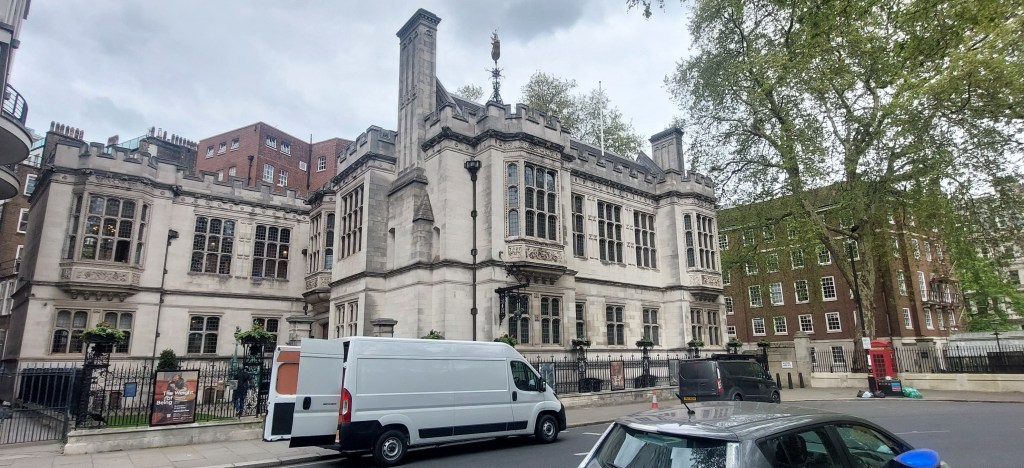
My second stop was 2 Temple Place, an eccentric mock Tudor pile by the river built by the American financier William Waldorf Astor. There was an exhibition of art inspired by issues relating to mental health advertised but I could not find a way in and the main door appeared locked. My walking, from there to the Tait and then north to Euston and my hotel, took me around the various Temples or law courts. This is an area that I do not know at all well and must explore further at some time, especially as I noted a pamphlet recently in one of David’s buys on the Temples that no longer exist.
The core of my gallery visiting therefore was Tate Modern. The main draw was an exhibition of Nigerian Modernism, art from Nigeria just before and after independence. It was well worth the entrance fee (also £20). I was probably most struck by a room, early in the exhibition, devoted entirely to the work of Ben Enwonwu, who straddled the time of independence and who was educated and trained in the UK. He clearly gained quite a following in his own lifetime and a series of wooden sculpture made for the Daily Mirror building in the centre of the space were captivating. However, it was the way in which he used the Western obsession with masks, both in museum displays and through references to Nigerian cultures, that I found most fascinating. There was a reference back to Picasso, but also a use of imagery, style and the use of the human form that I knew and had picked up on in later African art.
Much of the rest of the exhibition dealt with various schools of Nigerian artists. Some of it referenced back to European styles and trends of the time, some was stereotypically ‘African’, but much of it was highly original. I think one of things that struck me was the commonality. This also linked to some of the art that I associate with my father’s time in Tanzania (also in the years just before independence) and his attempts to develop art among his students at the teacher training college, and also the contemporary Makonde arts that I also know quite well. There was, clearly, some kind of pan-African style emerging, that related to a pan-African political positioning, and that has no doubt been noted and written about by others.
It was in looking at the main, free, exhibition within the Tate, however, that I noted the new emphasis on the global, touching on, but perhaps not quite expressing, decolonisation. The arrangement was more on art and society, or art and form, but the examples came from across the world and demonstrated a really interesting juxtaposition of styles, influences and techniques. There was a common thread on responses to war, primarily civil war, and suffering and another thread around queer issues. This was a thrilling series of rooms and some amazing and captivating images. One that will stay with me came from a Pakistani artist depicting a naked youth at a dinner table, with an indifferent father and the families’ women in shadows, while behind him he was bombarded with, and overwhelmed by, the products of television, social media, Islam and politics. It was a powerful representation of the pressures of queer youth in a Muslim culture.
For all the global references, artists and imagery, however, the one space that had the most impact on me remained a room, right at the heart of the building, containing a series of Rothko paintings, originally created for a restaurant in New York. The room was dimly lit and the space was expansive, but still immersive. There was one other person, (on her phone throughout) but I found myself in an entirely other world, overwhelmed, and drawn into, the colours, the images, the paintings and the space that was created.
 Martin Stringer Quartet