Last week I attended what I think was my first live dance event since the end of COVID. It was a performance by the 2 Faced Dance Company at the Taliesin Arts Centre in Swansea. The three pieces were very different, and the final item, Reduxed, which is noted as the companies most successful work to date, was incredible, having real energy and danger as the young dancers threw themselves and each other around the stage. However, it was the first work, The Qualies, that has stuck in my mind. This was based on moves within a tennis tournament was danced to a spoken text, an article by a sports reporter visiting the qualifications round of a major tennis event.
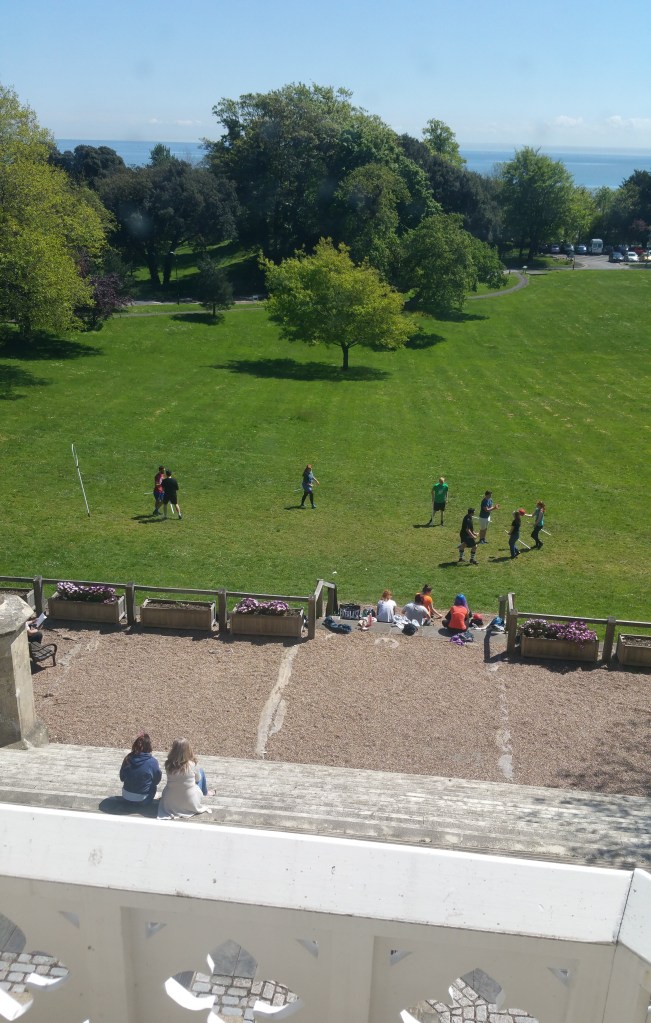
Playing Quidditch on the Meadow at Swansea University 2015 (MDS).
The text was almost as interesting, perhaps even more interesting, than what the dancers were doing on stage. One phrase in particular stuck with me. Towards the beginning of the text, the author asks whether any of us has the possibility of ever being in the top one hundred of anything in the world. The tennis players he is watching are all in the top one hundred, and part of the text focused on just how utterly different this is from the national championship games that he was involved in as a youth. It is a qualitatively different game and while he considered himself a good tennis player, he was never, ever at this standard. On the other hand, these qualifiers, however good they might appear to be, had very little hope of breaking into the real championships, there was another qualitative leap from this, albeit the top one hundred, and the really famous, celebrity, tennis circuit.
This set me thinking. Is there anything that I could be said to be in top one hundred in the world for? I might be considered among the top one hundred sociologists of religion in the world. That is certainly a possibility, but I am conscious that the sociology of religion has moved on since I last wrote anything or attended an international conference, and many people may have forgotten that I exist. Swansea University is not among the top one hundred universities in the world, and probably never will be, although we recognise that we really should be higher than the top 300-400 which is where we are currently positioned. This probably means that I could not be considered among the top one hundred PVC Education in the world. And, quite frankly, I cannot think of any other context in which I could sensibly be considered among the top one hundred in the world.
What this led me to contemplate, however, is what it takes to be among those top one hundred, and why my own chances are probably very limited. It also relates, in a less direct way, to what it might take to get one of the top one hundred leadership roles in the UK Higher Education sector.
At one level I would, of course, need to demonstrate innate talent, experience, ability, personality and so on. I am going to take it for granted that I have all those, especially when it comes to the ability to run a University (I clearly do not have what it takes to be among the top one hundred public intellectuals, novelists, composers or whatever else I might dream of being among the top one hundred in, but I do at least have a chance of being top one hundred in University leadership).
Given the innate talent etc., there are still four other elements where I think I lack what it really takes to be in the top one hundred: Focus, Networking, Self-Promotion, Selfishness or Self-Centredness.
I have never been good at focus. I have always tried to do too much. The fact that this blog series is framed as a quartet says that I cannot easily focus on one thing. I do not have obsessions and I have never gone out of my way to make myself the best in one field at the expense of all other interests and concerns. I have often thought about whether I should concentrate on one activity, or one agenda, and become a recognised ‘expert’ in that. That might be urban religion in my academic work, civic mission, EDI or student voice in my role as PVC education, or perhaps as a writer or artist of some other kind, leaving the academic and the university roles behind. I can dream, but when it comes down to it, I have too many interests, far too many interests for my own good, and I find it very difficult to focus, to concentrate on one and say ‘no’ to the others. I end up being a jack of all trades and a master of none (to use what now seems a very sexist phrase) and I end up not being known more widely for anything in particular. That will never help me become the top one hundred at anything.
Networking is something that I know I am not very good at. The idea of meeting up with, and initiating conversations with, other people, especially if it is simply for the purpose of ‘getting on’, is something that I find very difficult. This is the one area where I have worked most systematically through coaching and otherwise, and I have improved. I can do it, but it is so much hard work. It goes against my natural shyness, or latent asperges, I really do not enjoy it. Being online does not help. Cold calling by email, even to seek help from others, is something I continually put off and need to psych myself up to do. This is a real handicap, but in the contemporary world, you need to be known in the right networks if you are ever going to advance within any of those networks, that is to become one of the top one hundred in the world within those networks.
This factor is closely related to ‘self-promotion’, but the two are not the same. You can promote yourself, get your name out there, let others know about your existence and achievements, ideas, hopes and dreams, without ever networking. The same factors, however, limit my motivation to do either. I am not sure which comes first, a real distaste for self-promotion, or a significant fear of engaging with others. Ironically this blog, and other similar techniques, are part of my own attempt to overcome that drive against self-promotion. I am doing this on my own terms, and I am, perhaps, convincing myself that there is nobody out there who is reading this stuff. However, you are never going to be in the top one hundred in the world if nobody else knows who you are and what you can achieve. And, quite frankly, in today’s world nobody is ever going to know that unless you tell them yourself. Reputation in the social media world is self-built, you simply cannot rely on others, or the wider grapevine, to do this for you. That is one thing I have learnt very clearly.
So that brings me to ‘selfishness’. I guess the real term I should use here is the more morally acceptable ‘self-centeredness’. If you want to be in the top one hundred you must put yourself first, sell yourself certainly, but also focus, single-mindedly, on that attribute that you want to be recognised for, and, by implication, ignore all calls to help others. As noted in the previous blog, that is not my style. I will always credit others with their achievements. I will always help other to grow, to develop and to flourish. I will always put others before myself unless I am part of an application or interview process, where such activity really does not work, and that, in the aim to be top one hundred, is clearly a failing.
Perhaps, in the end, other things are more important than being in the top one hundred. Perhaps I have also been in higher education too long if I am consistently asking myself if I need to be better in this or that league table. Perhaps I should be asking a different question.
 Martin Stringer Quartet