My next writing project is to be a book on ‘myth’. This is part of the wider project to produce a ‘general theory of religion’ that I have been working on since the mid-nineteen-nineties. The overall structure of the project has hardly changed at all, the details of the individual elements continue to develop. At the heart of this project is the place of the story in relation to religion. In my first book, On the Perception of Worship, I outlined how the story plays such significant and central role within the worship of the Baptist Church that I studied, and by implication, in all worship. The essence of the story, I suggested, was that it could convey human experience without having to describe that experience explicitly. The story implicitly says, ‘it was like this …’ and expects the listener/reader to draw on their own experience, empathy, or emotions to communicate the core of the human experience/emotion being conveyed.
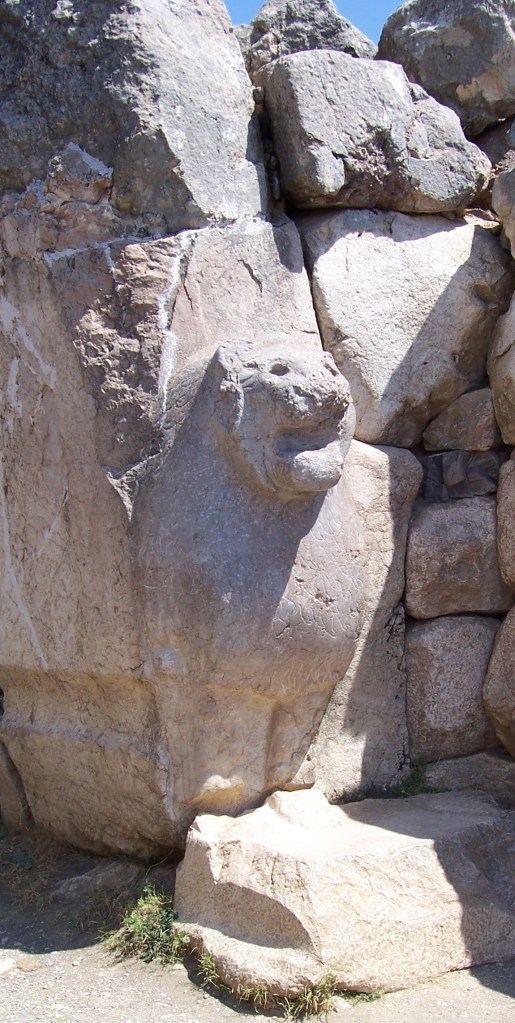
Hittite ruins in Eastern Turkey (MDS 2005).
Any standard of theory of religion would be expected, at some point, to engage with the idea of myth (or story), which, alongside ritual, religious experience, symbol, belief, and other elements, is understood to be part of the (Western, Christian) construction of religion. It is almost inevitable, therefore, that in a multi-volume work on the theory of religion, the concept of myth would be touched on, and discussed at length, at some point. That, therefore, is my next project.
After engaging with a series of theories of myth within the literature I am clear that I do not want to distinguish any particular set of stories as ‘myth’. Myth, like ‘religion’, has a Western, although far less obviously Christian, foundation and is not, in my view, particularly helpful in understanding the nature of religion in the world. My emphasis, therefore, will, throughout the new book, be on the ‘story’, and I am happy to include almost any story, or hint of a story, within the compass of my work. This will probably make it far too big and unwieldly to be manageable. However, that is my goal.
The starting point, however, will undoubtedly be the classic theories of myth, and it is in that context that I have been reading various works, classic and other, on myth, just to see what there is out there. The latest of these is Wendy Doniger’s The Implied Spider. I was somewhat frustrated by Doniger’s work at the start, not least because of her deliberately playful use of metaphor (including the implied spider of the title) which I felt distracted from the development of the ideas and appeared to be there just to look clever and well read. However, I soon got used to the rather overblown style and even began to enjoy it.
The other frustration was that for Doniger myth is primarily something that is written down, or perhaps more accurately, all the examples of myth that she draws on (and she does have a very wide definition, that seems to encompass fairy tales as the primary example) are literary. She is a specialist on India and Sanskrit literature, so this is perhaps not surprising. However, it does seem to limit the range and breadth of analysis that is possible.
Where Doniger is interesting, and what is the real focus of this book, is in her defence of the comparative in the study of myth. This is not a fashionable approach and Doniger is clear that she must defend her comparativist approach, both in method and in its underlying assumptions about the universality of the human condition (or of diffusion, that she attempts, but in a much more half-hearted fashion). Given that many of the classic theories of myth are fundamentally comparativist, and it is that comparative approach that has come in for the most sustained criticism, this is both a refreshing read and a powerful defence of what some might see as the indefensible.
The one thing that came out of reading this book for me, however, was a reinforcement of what my own book will be, and what it will not be. Much of Doniger’s approach, and her assumption about why we might be interested in myth in the first place, focuses on meaning, and hence on content, as the key element that needs to be investigated and compared across cultures. She is not naïve about this. Far from it, meaning is multivalent and constantly shifting, always context specific and probably undefinable for any particular telling of a myth/story. It is, however, content/meaning that she is constantly referencing and seeking in her defence of the comparative method.
For me the content, as such, is not that relevant, and hence I have less interest in the comparative, and none at all in its diffusionist version. What interests me is the social context of the story, its place in society and the way in which it acts (not ‘functions’) to mould, or reinforce, or transform social actions. From my perspective, the story is an active player in society, something that I must think through and aim to articulate in a better way than I am managing at this point. It is not as a literary element, or even as a plot or a narrative, that I have a particular interest in stories, it is the sociology of the story that I want to write, a rethinking of myth in a very down to earth, and yet at the same time, utterly transformative fashion. It goes back, in my own mind, to the idea that the story (any story, but equally a well-chosen story, or a story that is plucked from a bank of possible stories) is the means of communicating experience/emotion, that which cannot be spoken, that begins to make the story so important to a wider theory, or understanding, of religion.
 Martin Stringer Quartet