A new year, a new future. One of the things that struck me most forcefully in 2022 was the thought of my father’s age. On March 7th, 2022, he would have been 95. That is terrifying in so many ways.
My father was the youngest of six children, the only boy after five daughters. His eldest sister was over twenty years older than him and so his father, my grandfather, must have been born in the 1880s. I did know my grandmother, Grannie, as a child, but she must have been in her eighties even then, and she died when I was still young.
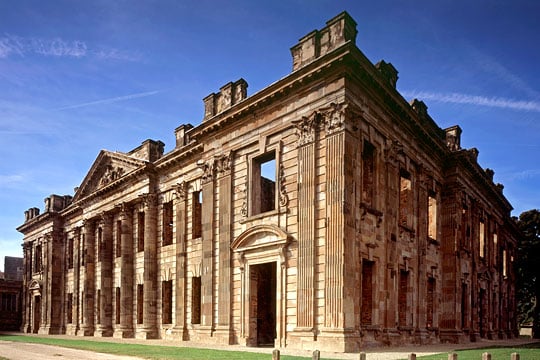
Sutton Scarsdale Hall, Derbyshire.
The world my grandparents had been bought up in was so very different from anything we can imagine today. The stories I have been told are almost Downtonesque. My grandfather, and my grandmother, entered service at Sutton Scarsdale in Derbyshire (which was closed, and asset stripped, in 1919). My grandfather was a chauffeur, and so, in the early years of the twentieth century somewhat ahead of the growing technology. I assume my grandmother worked in the kitchens or as a housemaid of some description. This is not a history that I have ever investigated. I am only aware of the stories as told by my aunts, and within those stories there are elements that were not spoken about. Some were dropped into conversation in hushed tones. Others are still gaps.
The earliest story is straight out of Downton Abbey as my grandfather and grandmother had to leave service because she became pregnant with my eldest aunt before they were married. It was clearly a love match, or grew into one, because the marriage lasted forty to fifty years and all the indications I have been given is that this was a happy family. My grandfather went on, eventually, to be chauffeur to Lord Kenning in the 1930s and 40s, a name that was still widely known in the car industry when I was child, but probably forgotten now. He also served in the First World War (we still have the postcards from the front, heavily censored of course) where, it is said, he was among the first to drive tanks. He died when my father was still a teenager, or young adult, but again this is a story that was never told, and I have never found out the circumstances of his death. For many years I had assumed that he had died in the Second World War, but I gather that that was not the case.
You can tell that I am not really into searching out my ancestors despite my love of Who do you Think You Are and similar programmes on TV. My fascination for such programmes, however, is more about the social history, seeing the events of the past through the eyes of individuals who played a part, and the uniqueness of those individual stories, rather than any larger interest in personal origins or my own inheritance.
My partner commented the other day that he felt that living in the contemporary world often felt like somebody born in the late Victorian era living through the 1960s and being confronted with miniskirts and sexual liberation. All the new technologies, global warming, the power of social media, conflicts over trans rights and what it is to be a woman etc. etc. mean that we now live in a very different world from the one in which we were bought up, and he, in particular, feels very much at sea within this new environment. Neither of us is entirely sure how to react and how to engage.
How far is that dislocation over the last sixty years equivalent to the one over the previous sixty years? We have lived through the last sixty years and, on the whole, the changes that we have experienced have been gradual. We did not experience two world wars, which are always said to have radically changed the social structure and values of our nation in the first half of the twentieth century. Nothing of that kind has happened in my lifetime, although the fall of the Berlin wall and the collapse of the Soviet Union was very significant, as was the growth of neo-liberalism, the rise of Islamic fundamentalism and the economic crash in 2008. All of these have changed the world we live in. More recently that change is speeding up, with the impact of the pandemic and now the war in Ukraine dominating, and changing, our world. Many of the certainties of my childhood and teenage years no longer hold true.
But it is more than this. My grandfather obviously watched, and participated in, a radical change in technology. As a chauffeur he was involved in the changes to cars, and less directly to planes and the impact of the combustion engine. He did not personally live to see the landing of men on the moon in the 1960s, but over his lifetime the technology of transportation, its democratisation, and its impact on trade, on leisure and on society must have been very apparent.
In our lifetimes that change has been within information technology. My mother worked with computers, preparing punch cards, in the 1950s. I took one of the very first ‘O’ levels in computer studies in the late 1970s, working at that time on a single BBC machine within the school. I wrote my PhD on a word processor, the latest technology of the time, and since then I have lost touch with the developments in gaming, personal technology and particularly in social media. Like the combustion engine for my grandfather the impact of information technology on society has been complete and in such a way that nobody could easily have predicted where it would lead. I live in a very different world from the one I was born into.
However, it is the values that have perhaps changed most dramatically, and which my partner was really drawing attention to when he said that he felt out of place within the contemporary world. My grandfather had to leave his job because he and my grandmother were to have a baby. The impact on my grandmother would have been even greater, and while they were married before the baby arrived, and therefore never really had the stigma of a child out of wedlock, the pressures on them both at the time must have been enormous.
I am gay, something that would have been unthinkable to my grandfather’s generation, although only one of my father’s sisters married (something, in part, to do with the post-First World War generation) and two of them lived with close female partners for all their adult lives. The revolutions in sexual politics and the acceptance of homosexuality through the second half of the twentieth century have been something that has been very positive for my partner and myself. But do we understand the younger generation? Can I really make sense of a recent survey that said that over 50% of young people at Oxford University saw themselves as fluid sexually and only a very small percentage as gay/lesbian? Does the level of offence that some of the attitudes that were so normal in my own growing up now cause – about gender, sexuality, race etc. – really sit comfortably? This is a different world, and we can very easily feel alienated and somewhat out of our depth. But somehow, we still make sense of it, and perhaps even celebrate it.
And what of the next fifty years, the lives that our current students are going to experience? Who knows? One thing I am very sure about, however, is that I will not be around to see it. Roll on 2023…
 Martin Stringer Quartet
You have highlighted both the past and the present. We enjoyed your writing. Modern world is really hard to fathom. There are complexity, changes in outlook towards life.We are doing so many things which were unthinkable to our early generations.
The changes have been ripping through our lives also. But our social values are strong enough to avert bad changes. However thanks for presenting real scenarios.
LikeLike
Thanks for presenting past and present. We
enjoyed your writing.
LikeLike