One of the books I read over Christmas was Susan Vogel’s book on the Baule, based on an exhibition at Yale in 1997. It was not so much the art that struck me, or really the ethnographic details of the Baule, although that did illuminate certain elements of our visit to Ivory Coast back in 2019/20. What kept coming back to my mind was the question of regionalism in religion. For some reason this is something that has fixated me for many years and I am still not really sure what my answer is.
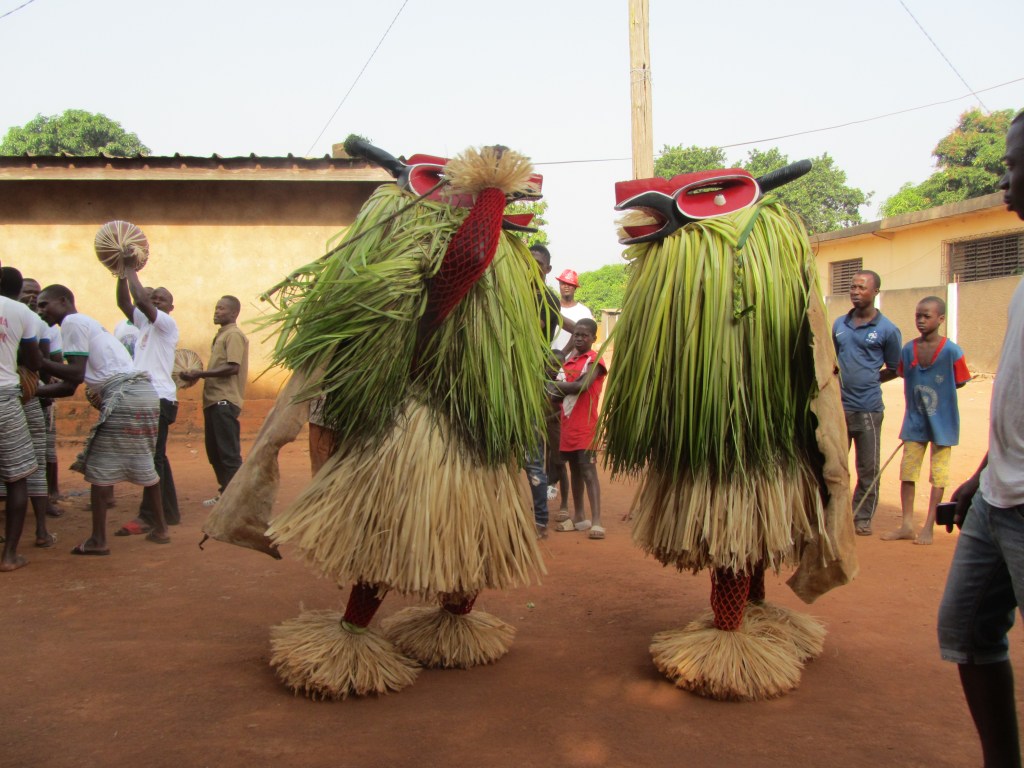
Moli masked dancers among the Baule, Cote d’Ivoire (MDS 2019)
What I mean by ‘regionalism in religion’ is the suggestion that religious principles, ideas, rituals etc. have a commonality across a wider area. The question, however, is how wide is that area, and how coherent do the ideas/acts etc. have to be to support the theory.
The principle goes back to my days in studying anthropology at Manchester in the 1980s and early 90s. The emphasis there was on specific cultures. The idea that cultures were fluid and merged into each other at the edges, or that they did not exist as coherent wholes, was part of the mainstream at the time, a reaction against the mosaic of distinct, and collectable, cultures of the previous generation. Fredrik Barth wrote a text about the fluidity and flexibility of culture in the middle east way back in 1969, and other writers were exploring regional ideas in New Guinea, the Pacific more generally and elsewhere. However, comparative analysis was certainly out and the idea that we could talk about wider linguistic or cultural regions was being frowned upon. I am still not sure whether this is an appropriate level in which to do such analysis or not, nor, if I am honest, whether it really matters.
Having travelled extensively in West Africa then the question of regionalism comes back, again raising questions about what kind of ‘region’ matters, and for what purpose. A distinction can be made between Francophone and Anglophone countries of the region, but that, as our latest visit to Ghana showed only too clearly, is very superficial (as is Christian vs Islamic). The traditional subdivision of anthropology is between the coastal peoples, the forest peoples, and the peoples of the savannah, but again that does not really work. My own reflections on religion in this area tend to focus on what is common across the whole region – West Africa – especially in terms of traditional religion, or the base level of thinking about spirits, souls and the like.
Vogel makes some interesting comments on the Baule. These people have traditionally been associated with the wider Akan, with stories that focus on the migration of ancestors from the Akan heartlands in Ghana. However, as Vogel makes clear, there are also stories of indigenous, autochthonous origin based around people who emerged from the earth in the area where the Baule are now based. Add to this traditions/dances that have been bought, or borrowed, from neighbouring, and clearly non-Akan, peoples and the particular mix of rituals, dances and art styles that form the current Baule corpus is a mixture of many different traditions and influences.
So do the Akan, in their wider form, which includes a certain linguistic commonality, form a region that shares a common approach to the spiritual? I don’t really think so. The ‘region’ that I would want to focus on is somewhat larger than this.
Vogel also draws attention to some of the cultural, or religious, principles underlying Baule thought processes. One is the distinction between village and the bush that can be seen across much of the West African region. I have come across this within the Dogon and many other peoples from very different parts of the ‘region’. Associated with this is the populating of the wild spaces, the bush, with amoral spirits and the need either to placate or tame these spirits in ritual, dance and masking. The particular form of these spirits may be very local or have wider application (and can be shared across peoples as Vogel illustrates) but they have a similar and consistent relationship with the humans of the village and are distinct from any kind of ancestor.
Likewise, there is a widespread assumption that the individual not only enters a different world at death, but comes out of that world at birth, and maintains links with that other world throughout their lives. This links to the idea of ancestors, a subgroup of those who pass into the other world, whose particular role can vary considerably, as can the depth of genealogy that is recognised. However, the place and recognition of ancestors in some shape or form is also widespread.
A final commonality is seen in a shared understanding of humans as being essentially both male and female. As Vogel notes, most societies in this area, especially those from further north, see the female part of the male in the foreskin, which is removed at circumcision, and the male part of the female in the clitoris, which is also often removed in traditional societies. For the Baule, however, this is reflected in a different way. Each person is said to have a spirit husband or wife in the other world, who can seek to influence an individual’s life. This spirit spouse then needs to be placated, or otherwise engaged with, most commonly through the commissioning of a statue to which offerings are made. Vogel notes that to her knowledge this view is unique to the Baule although she does say it only became apparent in the 1960s so there may be other societies who share it, but for whom it remains secret.
This leads on to a different kind of commonality, the hidden nature of much of the art, whether masks or statues, and the limited information those outside any one of these societies actually possess. There are so many overlaps here that I can see between the Baule and Dogon, and also know of in Nigerian and other West African societies.
The question remains, however, of whether all these commonalities actually reflect a specific, regional or West African approach to the sacred. There are undoubtedly societies in this region that share few, if any, of these traits, and were that the case then does that automatically negate the theory? The different traits may well have different distributions across the area. The traits form a kind of cluster that often, but not necessarily, come together, and are shared widely across a region, South of the Sahara and from the Atlantic coast in the West to … well where? Or is the distribution somewhat smaller than this. Is the western Atlantic coast different (I know far less about these societies)? Is Nigeria actually a very different region in religious terms? I don’t know, and that is what puzzles me. The West African way of thinking about religion and the spiritual (which consists of far more than the traits specified here) is very different from that of Northern Europe (whether considered traditional or Christian), but does that really tell us anything very significant?
 Martin Stringer Quartet