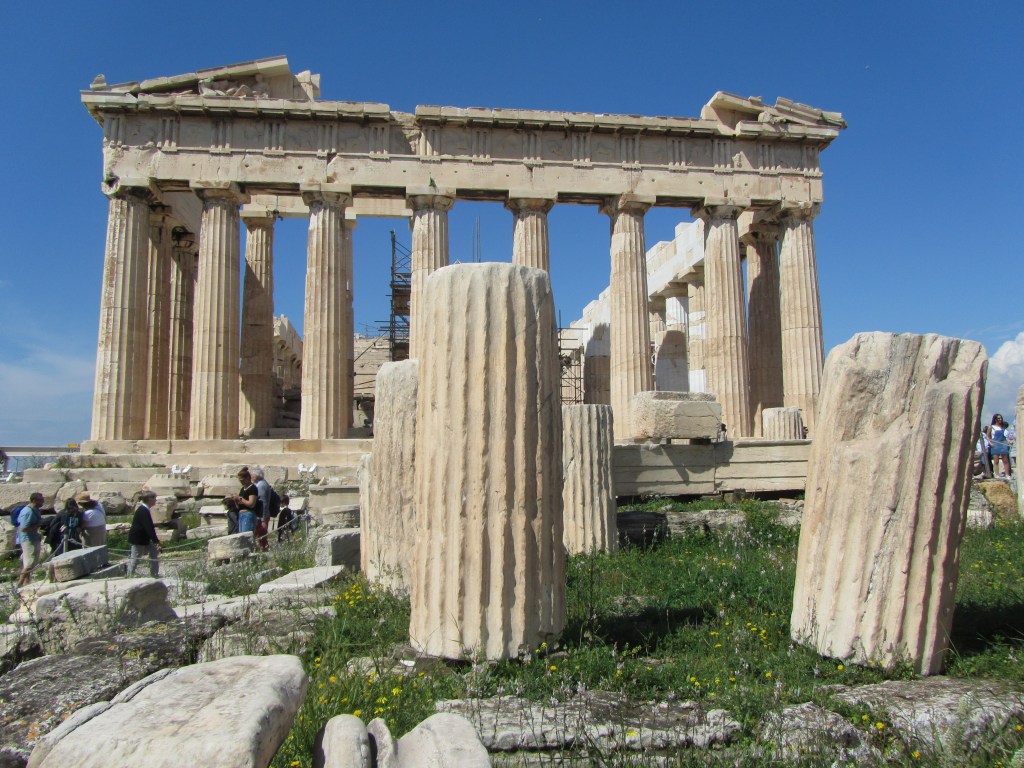
I am currently wading my way through J. G. Frazer’s multi-volume Golden Bough. I always tell my students about the importance of reading the original text, rather than relying on other people’s summaries or even the popular edited versions. So, I am now in the middle of many different examples of May Kings and May Queens and the weddings of the gods to bring fertility on the crops. However, that is not the point I want to make.
On page 123 of volume two Frazer quotes Pliny as saying, ‘the woods were formerly the temples of the deities, and even now simple country folk dedicate a tall tree to a god with the ritual of the olden time’. This simple quote sums up in many ways the message of much of the Golden Bough. All the local European folk customs, the may poles and the various mummer plays etc. are, for Frazer, remnants and reminders of earlier, classical or Celtic rites in which gods were married in rituals that re-enacted the events of heaven, which in their turn are developments of even earlier, and somewhat cruder, magical rites (which are often supposed to include some form of human sacrifice) in which homeopathic magic is enjoined to make the crops, or the cows, or the women, fertile and produce plenty. It is all beautifully written with a wonderful turn of phrase – and blatant racism and colonial privilege – but at its heart is the view that real religion existed only in the past and is now lost to humanity, that it is currently present only in quaint survivals.
Frazer was not, of course, the only nineteenth century writer on religion to think in this way. The idea of the ‘survivals’ as it is more generally used in older forms of religious studies, originates from Tylor who uses the term to refer to remnants of older forms of culture that are still present, but often out of place and drained of their original meaning, in contemporary society. For Tylor survivals can be seen in all aspects of life, not just religion. In the wider discourse, however, it is religion, more than any other areas of culture, that is seen to be the province of the survival.
However, as the quote from Pliny suggest, this view is far from being new, even in the nineteenth century. There is a consistent thread in writing about religion that suggests that real religion was only present in the past, at least in its purest form – ‘the ritual of olden time’ – and the product of more innocent times – ‘simple country folk’. There is a thread of this kind inherent in Christianity that leads reformer after reformer to look back on their particular interpretation of the early church as the epitome of all that is true, and all that is pure, in ‘real’ Christian faith. The fact that we also see this in Pliny, and perhaps in many other writers and traditions, suggests that this is one of those understandings of religion that is not uniquely Christian, or uniquely modern.
What I take from this, however, is a more contemporary reading, and this is perhaps something that I might want to develop further in my book on myth (where, like this blog, I could perhaps relate it to the work of Frazer and his colleagues). We can still find plenty of evidence for a discourse that says religion was better, purer, more prevalent, in the past. However, in a world that does not hold religion in such high esteem there is little incentive to see contemporary religion as particularly corrupt. For much of contemporary society (at least contemporary northern European society) religion has always been corrupt, patriarchal, and extremist. There never was a golden age when it was anything else.
Again, this is not my point, and is perhaps looking at the issue far too narrowly. If the focus is switched to ‘myth’ rather than the wider concept of ‘religion’ then we still instinctively view myth as something that comes from the past. The Greek myths are an obvious, if rather banal, example. But the idea that myth has a hold over society, that people take it seriously, even if they might not have believed it as actual truth, is something that is seen to be true of previous generations, more innocent generations, and something that we have grown out of. Again, Tylor states this explicitly. For Tylor the nineteenth century is the era when poets still allow us to see the potential for believing myth to be true, and science has not yet cut off the older ways of thinking completely, although for Tylor that will happen soon. Tylor, however, is not alone as I am finding in so much of my reading around the idea of myth.
One of the real points of my own book, by deliberately trying to avoid the rarefied concept of ‘myth’ and to talk instead of the ‘story’ or ‘narrative’, is to suggest that this is nonsense, that we still live in a society that is dominated by stories (myths) that we are constantly telling ourselves, primarily in these days through cinema and television, but stories that have a very significant impact on our thought processes and the way in which we structure our lives. These stories are not often recognised by ordinary people as ‘myth’, still less as ‘religion’, but they are, I would suggest, the current form of the ‘religion’ that Frazer sees in the folk customs of nineteenth century Europe, or the woodland rituals of the classical era, or any other form of powerful ritual story telling from any particular place or time in history or from across the world. The idea of a golden age of religion is, of course, itself such a ‘myth’, or it might be if we want it to be, but that is, perhaps, a different story.
 Martin Stringer Quartet