There is something wonderful about walking through a city. Don’t get me wrong, I love walking, full stop, rural or urban. However, there is something about walking in a city that is unique. There is also something extra special about walking in London, I am not sure what it is, but the intellectual heritage of Walter Benjamin, Michel de Certeau and others as urban wanderers, albeit in Paris, Berlin and wherever else, is part of my own academic background. It is the surprise, the variety and the ever changing street scape that always appeals to me.
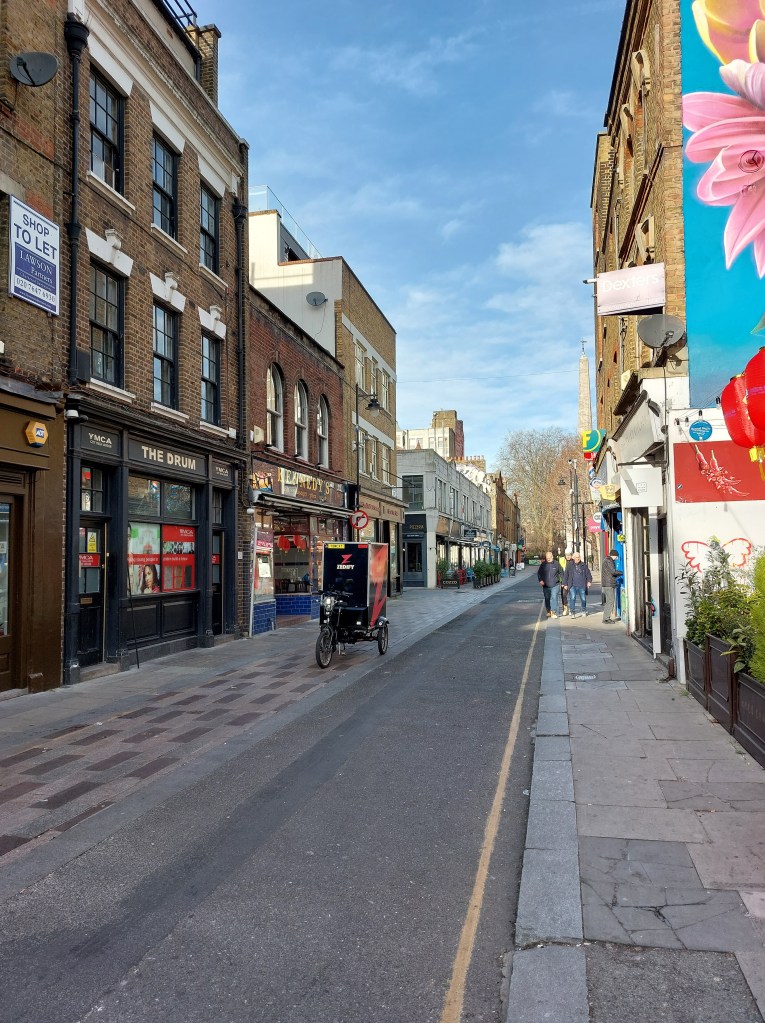
The other week I was in London at the time of the rail strikes. I had travelled down by bus, certainly an experience in itself as I have not travelled on inter-city buses in this country for many many years. However, it also meant that a number of my appointments were also cancelled as others had not been able to get into London. I therefore found myself with most of a day to kill. I was staying not far from Liverpool Street Station, almost totally unrecognisable amidst all the new building. The bus was leaving from Victoria, and there were a few places that I wanted to visit, a gallery just north of the Barbican, my favourite French restaurant for lunch in Seven Dials, a coffee shop in Soho, and somewhere to buy some new shirts. It made sense, therefore, to spend the day, simply strolling, from east to west, across the city.
I began heading a little further east, to the Whitechapel Gallery, that did not open till half an hour or so after I arrived. I walked down Brick Lane and pas Spitalfields Church to the market. Just beside the church I passed a street of old Huguenot houses. It was the first time I had seen these streets, and had no memory of even seeing them on screen. They were amazing in their solidity, elegance, and uniformity. A beautiful surprise, which is exactly what walking through the city is all about.
The market was a good place for coffee and a chance to look at the craft stalls etc. And then heading West, across Finsbury Square and out to find the gallery. This was another part of the city that I had not known, a collection of streets north of the Barbican and south of Old Street. Here I met the first of a number of street food markets that I was to discover as I walked across the city.
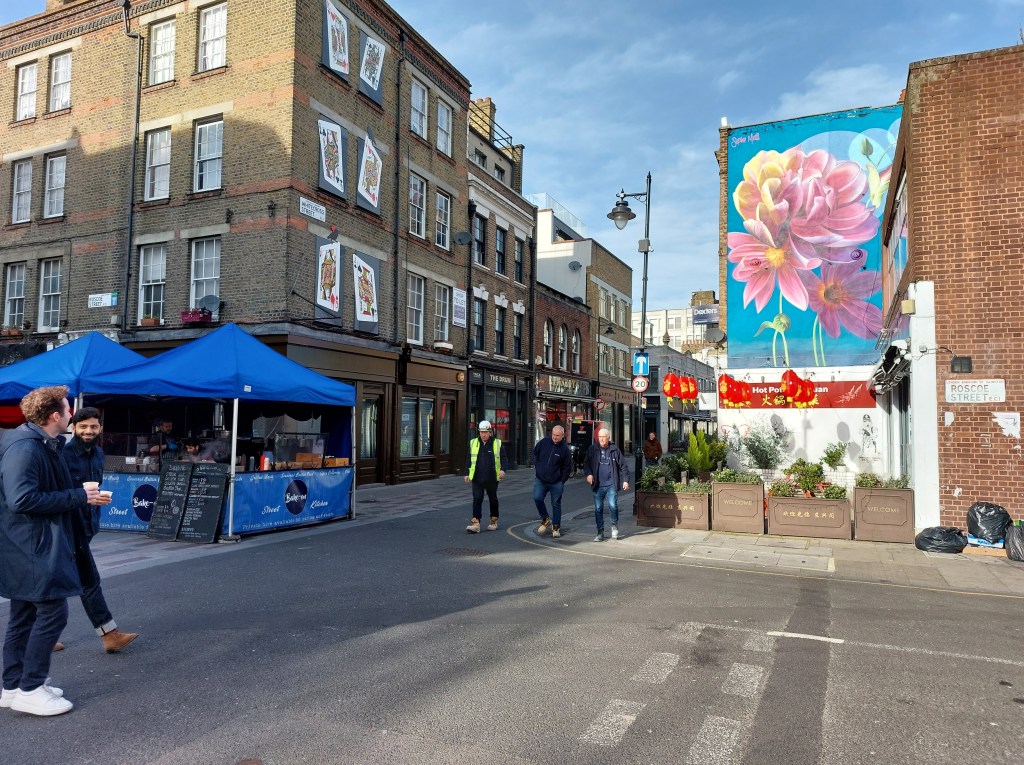
The gallery was amazing, and more of that in a future post. The area around it, however, the Golden Lane Estate, was also interesting. Mostly old East End warehouses and more recent flats that still had a bohemian feel (murals adorned the walls alongside the street food stalls) and interspersed with typical East End pubs and small shops, miniature village communities tucked into the city. From here it was down Old Street, through Farringdon, on to Clerkenwell Road and Theobalds Street. It was an easy enough walk, and some parts (St John’s Gate and Hatton Gardens for example) were well known. Others, particularly Grey’s Inn, were new to me. From Bloomsbury, through Seven Dials, Soho, Piccadilly, and on down to Victoria were all familiar ground for me.
One of the things that always thrills me on a walk of this kind is the subtle transformations. There are some points where the change is dramatic and immediate. There are always buildings and/or other features that stand out, that shock and that demand attention. For much of the journey, however, given the pace of walking, the change is gradual and the transformations only apparent when you find yourself suddenly immersed in a new part of town, and new series of shop fronts or building forms. The walk is slow and while the change over longer distances is always dramatic, especially in London, the experience is surprisingly restful.
Another feature that always appeals to me, and is as true of walking in rural landscapes as it is in urban contexts, is the layering of the landscapes. In rural walks it is often the long view, the vista that is conjured up by the landscape as a whole, that allows you to reflect on the layering and how the past has influence and moulded the present. When walking through a city, or at least one with limited hills, as central London, then the long view, the wide vista, is rarely seen (although looking back at the buildings bordering the train line as I crossed just north of Farringdon station, or looking south across Hyde Park towards the skyline of Victoria are both significant long views with incredible points of interest). It is primarily the immediate, and the transition from building to building, the layering that is both horizontal and vertical (always lookup when traversing the city, many of the more interesting features are above the shop fronts) and that speak of histories, of the many different forms that this city has taken. I love the work of Peter Ackroyd, and that always speaks to this layered nature of the city, with the older cities, the lower levels, always pushing to break through into the present and the current vision.
One thing that I did miss on this walk, however, were the people. Even in the more crowded areas around Soho or Piccadilly, the people did not impose themselves as much as they might. Perhaps I had already phased them out, had entered into my own head, and I was meditating as I viewed the architecture and the streetscapes through which I was travelling. One point where people did interrupt the walk, in a very surprising way, was a series of photographs in the window of Grimshaw Architects. These were by a Nigerian photographer and showed ordinary people in their domestic spaces in either London or Lagos. Amazingly powerful images! But that is what walking across a city is all about, the unexpected, the original and the emotionally powerful. Highly recommended.
 Martin Stringer Quartet