The surprise gift this Christmas was a copy of Tales from the Trigan Empire, a large comic, or graphic novel, volume published in 1989. This is clearly not the kind of thing that I would normally read, but it brought back so many memories of childhood. When I was eleven or twelve (1973-74) my parents subscribed to the children’s magazine Look and Learn and each week I devoured all the different, undoubtedly educational, articles within it. I always left the best bit till last, the back cover, which contained the next instalment of the Trigan Empire. I do not now remember anything about the content of the magazine, except for those images, drawn I now know by Don Lawrence, and of those I remember only one of the stories (but more of that later).
The Trigan empire is essentially Rome with added technology, a kind of ultimate steam punk taken way beyond the Victorian era. The costume and the social context are Roman. The technology is, or was, somewhat ahead of the contemporary with atmospheric flying craft, hover vehicles, space travel and ray guns. The stories were heroic and always had a happy ending, although they could spread over many weeks with serious scrapes and cliff hangers from week to week.
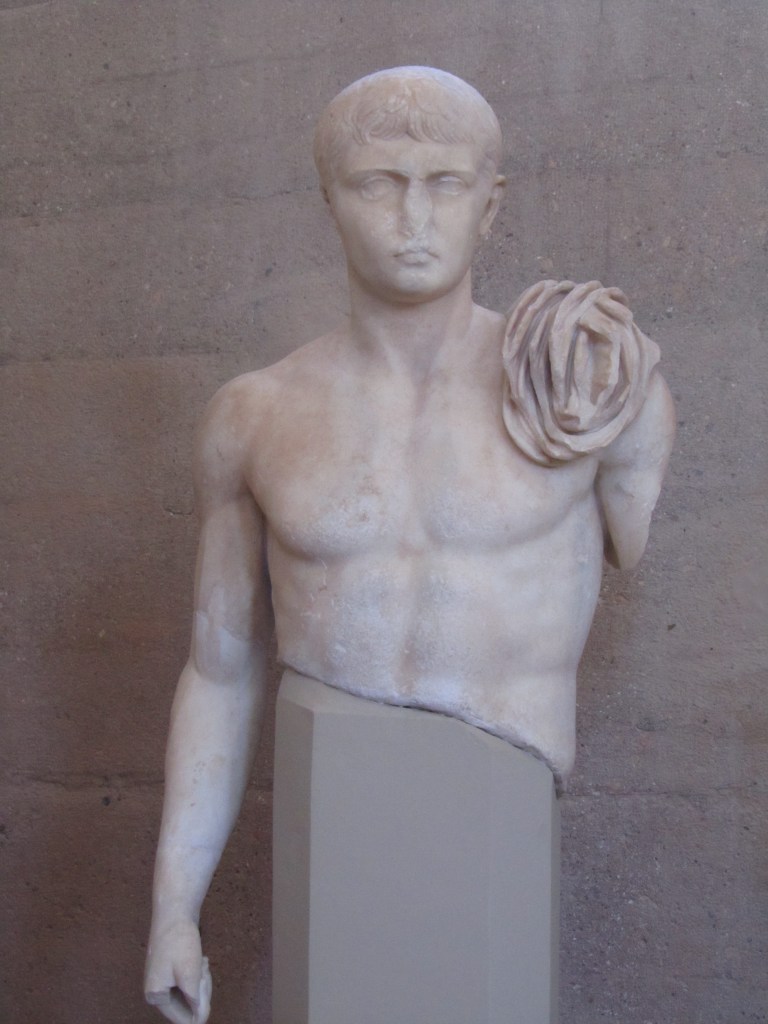
What attracted me was inevitably images of hunky young men in short skirts. This was an entirely homo-social society. It was clearly misogynistic, although to be fair women were simply absent, and even in the book version there are only two or three female characters. The heroes end up, very briefly, in one story in a society ruled by female warriors, but otherwise the women, with one exception, are bit parts or entirely absent. The only woman with anything like an important role is the daughter of the chief scientist, philosopher, and inventor of the Empire.
Having no women there is also no romance, no love interest, no distractions from the heroic activities of the key players (the emperor, his brother, his nephew and the nephew’s companions in the imperial air force). The villains, and even most of the monsters, as far as one can tell, are also entirely male. This is not homoerotic, apart from the images. It is not erotic at all and does not hint of relationships of anything other than friendship between the core group of companions. This is original boys’ own stuff, boys who were not expected to be interested in girls, or at least not yet.
The stories are also implicitly, and often very explicitly, racist. Even in 1989, when this book-long version was published, it all looks very dated. True, the leading figure, Keren (the emperor’s nephew’s best friend) is always coloured blue and has dark hair. He could, at a push, be seen as ‘black’. The emperor and his family are all blond haired and clearly white, if not distinctly Aryan. It is, however, the enemies, the ‘savages’ and ‘barbarians’ beyond the Empire, and even the peasants within it, who are represented in very stereotypical fashion (more Middle Eastern rather than from the far east or Africa). In this it also, perhaps, represents a ‘Roman’ attitude to the other. Those within the Empire, of whatever ethnicity or colour, could be Roman and a citizen of Rome, while those beyond the borders of the Empire are barbarians and somewhat less than human.
So why has the Trigan Empire stayed in my memory? Partly, I guess, is that I was reading it at a very impressionable age, the age for which the stories are clearly written. It had heroism, adventure, risk, hand to hand combat, evil villains and monsters, technology and style. All this made a strong impression on me and many of the images have stuck with me. But it is the one story that I remember that probably has much to do with the lasting memory.
I was not a fast or prolific reader as a child. Dyslexia meant these graphic narratives became more significant. I was also never allowed to read real comics (Batman, the Eagle or whatever) as my parents didn’t think that they were intellectual enough. It is rather ironic, therefore, that the one element of the (obviously intellectual) magazine that they did buy for me I appreciated, and remembered, more than any other was the comic strip on the back. However, this was also one of the few arenas, before the age of about thirteen when I did take to books in a big way, that I engaged with narrative and story, and so with the intellectual ideas that were contained within those stories.
The story I have always remembered is not contained in the volume I received for Christmas. It moved away from the emperor and his family and started with man in a crowd who buys a lottery ticket from another man in the crowd. The lottery ticket, inevitably, wins and the man who bought it gains a great fortune. The person he buys it from is furious and starts to stalk the winner, discovering in the process that he has invented time travel. I forget how the story concludes, what was needed to destroy the time machine, or whatever else might have happened. It undoubtedly had a happy (distinctly moral) ending, all these stories do. What has always struck me, however, was the stark expression of the dangers, and possible benefits, of time travel. I was undoubtedly watching Dr Who at the same time, but that did not have the same immediate impact.
It was the written/drawn form of the story that fixed the idea in my head. The wider frame was also significant, the imaginative leap to a Roman society with contemporary technology. This also raised interesting intellectual questions and narrative possibilities. It has always been the ideas contained in narrative, their implications, variations, multiplication etc. that have interested me, and, it appears, I probably learnt much of that, for the first time in a conscious fashion, from the stories of the Trigan Empire. It is good to be reminded.
 Martin Stringer Quartet