I gave a paper at an event at Birmingham Newman University to celebrate the recognition of St John Henry Newman as Doctor of the Church. This is the text, in three parts:
Summary
In summarising what I have tried to address this morning, I would highlight three points that I have learnt from reading Cardinal Newman’s Idea of a University:
First, the university is the totality of its people, its academic staff, its professional staff and its students. It is wrong to see any one of these as distinct, or more relevant, than the others. Our teaching, our research, our public engagement are all part of the shared responsibility of the community as whole. We might also want to include in this our Council, our alumni and our partners in industry, civil society and the community around us. This is what the ‘university’ of the twenty-first century must be seen as, and all our activities must be fully inclusive of the whole of that community.
Second, we must recognise the interconnection and mutual interdependence of scientific and theological, or moral, truths. One without the other is defective and open to falsehood. For this reason, and not just because of the contribution of humanities and creative studies students to the economy, we must always argue the case for a balance between science, technology, humanities and the creative arts within our institutions.
Third, we are living in dangerous times. There are those who would seek to undermine, if not to destroy, the idea of the university as set out by Newman and by many others over the last hundred and fifty years. Our position, particularly as Catholic heritage universities, is to stand up for that tradition, to undertake the difficult and critical thinking necessary to make our case. Never resorting to simplistic essentialism or to simplistic relativism. This may not always be easy, but, with the vision of St John Henry Newman to lead us, and the confidence of our Catholic faith, I believe that we can stand firm and position ourselves to lead the fight for the relevance of the university into the second quarter of the twenty-first century, and for the next hundred and fifty years.
Part 1: Community
St John Henry Newman
St John Henry Newman’s The Idea of a University is probably the best known, and most widely quoted, books on what it is to be a university, although it was originally published over a hundred and fifty years ago in the middle of the nineteenth century. I was immediately struck, however, when I first read it, just how relevant the text sounds all these years later. Given everything that has happened over this time, that may sound a little strange. Have universities really not changed all that much in the last hundred and fifty years? Perhaps, but it may also be because Newman was onto something.
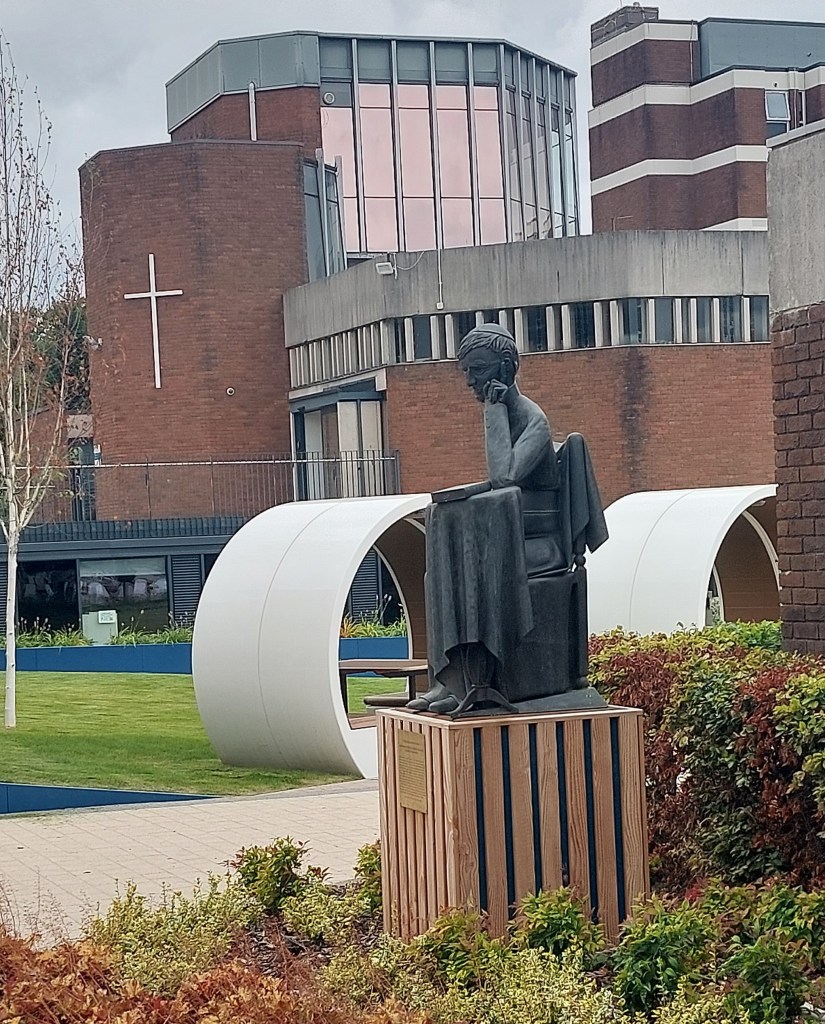
Newman’s book has been particularly influential in the States. Here in the UK, it is noted more as an historical oddity. This may have something to do with its age, but it is also related to the book’s very specifically Catholic, and less obviously, Irish context. Universities in the States tend to be less embarrassed by this, but even in the States the Catholic element has been largely ignored.
In the UK it may be thought that we do not have a strong tradition of faith-based universities. However, up till the nineteenth century the Anglican foundation of Oxford and Cambridge, and their position as ‘the establishment’, was taken for granted. At the time Newman was writing, in the mid nineteenth century there were challenges to this Anglican dominance with universities such as Edinburgh and, in a few more years, Birmingham and the other big civic universities, establishing a more specifically ‘secular’ stance over and against the Anglican establishment.
Newman specifically addresses the debate, that was occurring as he wrote, between the Universities of Oxford and Edinburgh. This was not, however, an argument about faith. It was an argument about the purpose of the university. Oxford claimed to place research and the development of knowledge at the core of their mission while the founders of Edinburgh University saw it as serving the needs of the local economy and providing the skilled workforce required to serve that economy. Newman, given his background, came down firmly on the side of Oxford. He did not argue for the economic value of the university.
Many of our current faith-based universities, those in the Cathedrals group, and including Birmingham Newman University, had their origins in the training of professionals to serve in education and in health. This is something that is still core to our own vision and strategy, but not something that Newman himself might have seen as the purpose of the university.
Community
Before looking at Newman’s argument in more detail, however, it is perhaps worth noting the context in which the lectures on which the book is based were originally given. Newman had recently been appointed, after some persuasion, to establish a new Catholic University in Dublin. He decided that his first act, or one of his very first acts, was to set out to the university what he felt a university should be, and therefore what he expected this new institution in Dublin to achieve. He presented his vision in the form of five lectures delivered to the whole university community, both staff and students.
This may sound to us to have been something of an ordeal. To stand and lecture to the whole university is something that very few vice chancellors would consider today. Most VCs do address the staff on a more, or less, regular basis within weekly, or termly, emails. All staff open meetings are still common. Many VCs also address new students through videos in welcome week, or maybe at graduations, but little of this ever outlines the VC’s vision of what the university is about as an institution.
What this process, the delivery of lectures to whole gathered community, demonstrates, for me, however, is that, for Newman, the ‘university’ is not the bricks and mortar, the physical buildings, it is the people, and what is more it is both staff and students.
I have often heard colleagues refer to ‘the university’ as some faceless entity that makes decisions that they are not a party to. We still speak of ‘the university’ as if it were the leadership team, or at most the academic staff, what the Americans call the ‘faculty’. Students, if they are considered at all, are those who are taught by the university, those who are clients of the university or those who are served by the university, not as an integral part of the university itself.
Newman places the students at the heart of his vision. If the university is not there, as with Edinburgh, to provide skilled workers for the economy of the city or country, it is there, according to Newman, to instil ‘character’ and to develop what he calls ‘gentlemen’, and specifically ‘Irish gentlemen’. This is not language we would use today, but it is this character-building purpose of the university that many American commentators turn to when they look to Newman’s vision of the university.
I have always argued that we must focus on the kind of graduate that we aim to produce. Perhaps not ‘gentleman’, but, in the modern jargon, we might claim that we are looking to prepare, not just ‘work ready’ graduates, but graduates who are ready for life.
While this is important, I also think Newman is going further than this. It is the purpose of the university, and by that he means both staff and students working together, to study together, to grow together and to seek, in mutual collaboration, after knowledge and truth. We often speak of the ‘student voice’, of ‘collaborative teaching’, of providing research opportunities for students, but do we really see the intellectual mission of the university as a fully collaborative activity, of students and staff working together, each bringing their own expertise and experience, their own questions and obsessions, their own cultures and their own faith, to push the boundaries of knowledge? I think not, and, I would argue, it might challenge all of us to reflect on what such activity might actually look like.
 Martin Stringer Quartet