Truth(s)
This takes me to the core of Newman’s argument, particularly in the lectures he delivered to the university in Dublin, the first five sections of the book. Here Newman is keen to emphasise the place of Catholic theology as central to his understanding of what a university should be. More accurately, however, and given the audience that Newman is addressing, Newman is arguing for the importance of studying science and other emerging disciplines alongside Catholic theology.
For Newman, both theology and science seek after truth. However, the truth that they are seeking is different, complementary and, in Newman’s eyes, they are both necessary to a complete understanding of the world.
Science is rooted in a truth that is based on empirical observation and the experimental method. It aims to tell us about the material world and enables us to engage with and develop technologies that allow us to solve the problems faced by this world.
Theology, for Newman, is based on revealed truth. It aims to answer very different questions, about what ought to happen, how to behave, and more specifically about the nature and value of the human person, and the created world, in the eyes of the Creator. This cannot be discovered through experiment or by any amount of scientific enquiry, but science, in Newman’s view, cannot progress without this other, revealed, truth.
Today, we are consistently being told that we must look to the evidence, that science, technology, engineering and mathematics, or medicine are the basis of economic advancement, and that they should be prioritised in our universities. Newman, perhaps, had to argue for a greater place for science in the universities (especially the faith-based universities of his own day). We are looking to a time when science is all, and ‘truth’ is equated with experimental, empirical, truth. But, as Newman would clearly appreciate, ‘truth’ is never neutral.
Truth and Untruth
I am currently writing a book on decolonisation, more specifically on the way anthropologists, art historians, tour companies and popular discourses have used the idea of the Dogon people of West Africa. The academic discourse began in the 1930s among French anthropologists. This was a very active time for intellectuals and artists within the French capital. Core to much of that debate, however, and particularly to the development of ethnology, was what we have come to know as ‘scientific racism’.
From the middle of the nineteenth century work had been underway to discover a scientific basis for racial difference, whether through the measuring of skulls, other physical features or, when that failed, of intelligence. This was an empirical science, rooted in measurements and experimentation, but also in colonialism, much of it was utterly demeaning to those on whom the measurements and experiments were inflicted.
The ‘science’ of race would have sat squarely in Newman’s field of scientific ‘truth’ but it led, among other things, to the horrors of the Holocaust. We know only too well that so-called scientific truths can be partial, destructive and morally false. Scientific truth, in this sense, cannot stand without some reference to Newman’s other truth, the theological, or we might say ‘moral’, ‘ethical’ or ‘social’, truth.
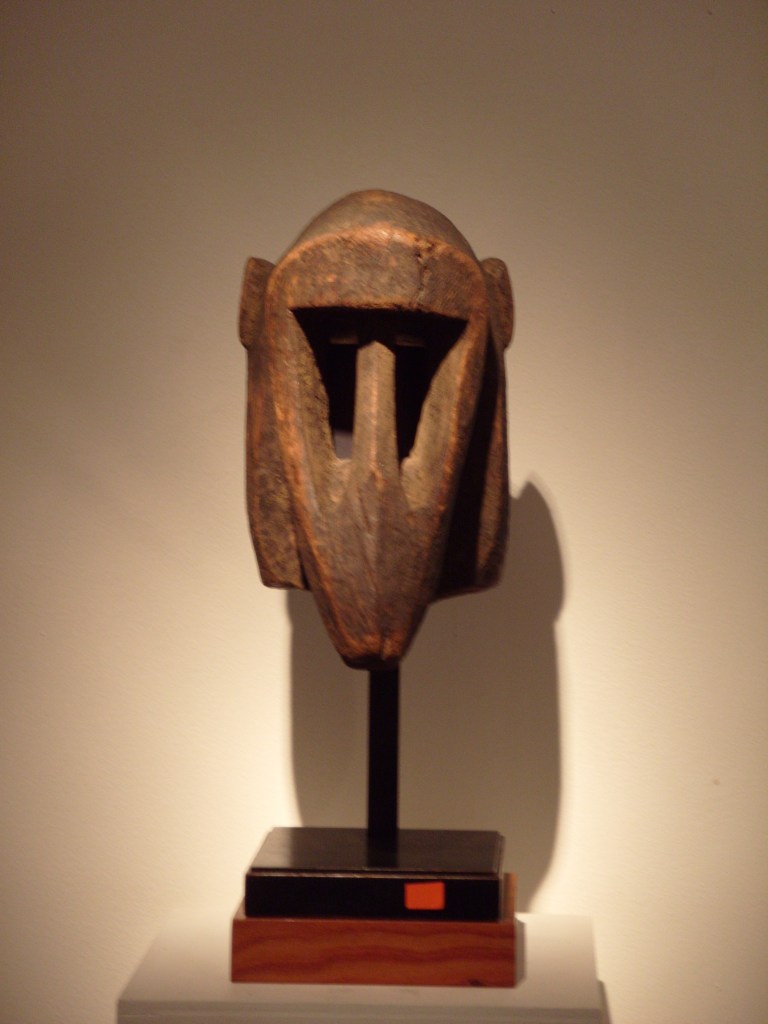
One reasons for my interest in the Dogon people is that I collect art that has been created by these people. On my shelf I have a mask, a black monkey mask. There are many truths that can be related to this mask.
We can enquire about its manufacture and use among the Dogon, about the symbolism and the stories that surround the black monkey of which it is a representation. We can also ask about how it was acquired by dealers, removed from the Bandiagara cliffs in Africa to Paris or to Brussels, exhibited, perhaps stored for a time in the collection of a museum, returned to the market and bought by myself. Each step on this journey raises difficult ethical questions and subjects the mask to a range of meanings and associations that are not always easy to identify or comfortable to confront.
For all these different truths, however, both scientific and ethical, there are certain statements about this mask that are clearly untrue. It is not, as some have claimed, the representation of a helmet worn by visitors to our planet from Alfa Centauri many millennia ago and preserved as a collective memory by esoteric priests on the isolated cliffs where the Dogon live.
We may, following the post-modern turn, want to talk of multiple truths, of different kinds of truth. We may also hear it said that any truth is possible, my truth, your truth, false news, deep fakes. In this context Newman’s emphasis on truth, or on the different bases for truth, becomes ever more important. We need to be very clear when we are talking about truth and when we talk about falsehood, or untruth and that is also part of the purpose of the university.
 Martin Stringer Quartet