Coming Out and Coming Out Again

When asked to write about my ‘coming out story’ shortly after taking up the position of PVC at Swansea University eight years ago, my immediate response was to ask ‘which one?’ I have perhaps been lucky, I never needed a big coming out event. Being gay is something I have always taken for granted and accepted as being part of me. My parents never had any serious problems with it, and, while I did have a long conversation with Mum, my Dad simply adjusted to the fact that ‘Martin has a boyfriend’ and that was fine. I have never in that sense deliberately ‘come out’ and yet I have found, over the years, that coming out is a continual process, something that has to happen in some shape or form every time I meet new people and want to them to understand who I am and to accept me for who I am.

This struck me particularly when I took up my role as Pro-Vice Chancellor at Swansea University. Before moving to Swansea I had been working in the University of Birmingham for over twenty years and most people who bothered to take an interest in these things knew that I was gay and had a partner. I taught on a module on ‘feminist, black and gay theologies’ for a number of years within the Department of Theology and Religion. Gay and lesbian students felt comfortable approaching me to discuss issues relating to sexuality, whether personal or theological and I appreciated their trust and openness. I mentored a number of gay or lesbian staff and students as part of formal LGBT+ mentoring schemes, and my partner was well known to immediate colleagues.

Being gay, therefore, was something that played no significant role as I increasingly took on management roles and moved up the University structure. I do remember, however, the mild look of surprise on the Vice Chancellor’s face when, having been appointed to a senior leadership position, I introduced my partner to him at an event organised for senior management to which my ‘wife’ was included on the invite (the University did not make that mistake twice!).

Having taken up my new role at Swansea, however, I was, perhaps for the first time, in a position where I have had to make a deliberate decision about when to ‘come out’ and how to do this. My standard response has always been to treat being gay as perfectly normal and to wait for conversations to reveal that normalcy. Many people asked me ‘have you got a family?’ The answer is ‘yes, David, my partner, two dogs, however many tortoises and a couple of chickens’. Others ask ‘are you moving to Swansea?’ and I have to say that it is unlikely in the short term as ‘my partner runs a business that would be very difficult to move across the country’.

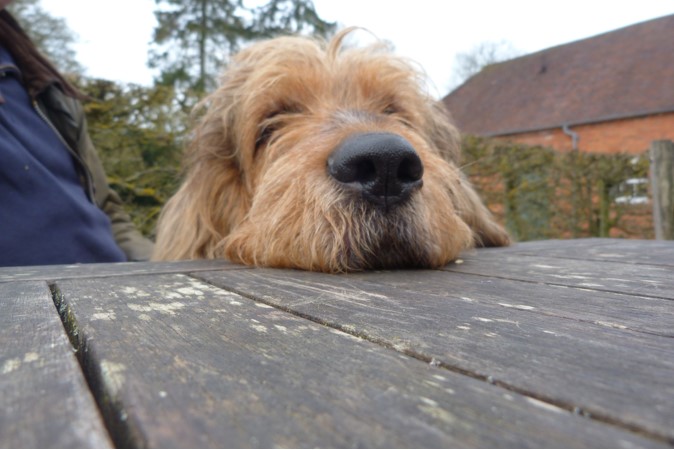
Very occasionally somebody apologised as if they have trodden on delicate ground, but for the vast majority the conversation simply continues, discussing the particular breed of dogs (otterhounds if you are interested) or specific issues around the antiquarian book trade. It is not a ‘big deal’ but I was perhaps more conscious of it on that occasion simply because of the very large number of new people that I met over the my first six months in post. ‘Coming out’, in that sense, never really stops, and now I have left Swansea and I am moving into new engagements and activities I can begin to see the situation emerge again. The only difference now is that I do tend to take the initiative. I make it clear that I am gay, have a longstanding partner, and this is part of who I am even before I am asked.

I do have to say, however, that the openness and welcome that I received in Swansea all those years ago made that process so much more pleasurable and reassuring. The support, and perhaps even the lack of any special interest or recognition that I was any different, has also been very significant. A university is, perhaps, a particularly positive place to be ‘out’, but I am also finding that in many other contexts being gay is not a big thing. Other people are less likely to make assumptions, and, as I said at the start of this blog, I know that I have been very lucky in this, and I remain very grateful.

Another Tragedy for Armenia

My partner and I have been passionate about Armenia for many years. We love Armenian music, Armenian art and architecture, the romance of the Armenian church, everything about Armenia, its history and its people. It is with great sadness therefore that we have been watching the news over the last week or so and seeing that, once again, the Armenian people are suffering and nobody, or practically nobody, is coming to their aid.

We have travelled to Armenia on two occasions, and twice to parts of eastern Turkey that have strong Armenian links. On our first trip to Armenia we travelled on to Georgia and I was very struck by the fact that all the stories we heard in Armenia were tinged with tragedy, not just over the last hundred years, but throughout its history, while those told in Georgia were stories infused with joy, if not directly with comedy.

The Armenian genocide, commemorated in a wonderful museum and monument in the heart of Yerevan is a moving and defining narrative for all Armenians. A whole population being slaughtered and driven out of their homelands in what is now Turkey, with many hundreds of thousands dying on the way. The current movement of people from Nagorno Karabakh holds memories of the genocide, but thankfully with far fewer casualties. I guess we can be thankful, even for small mercies.

A friend of ours lives in Gori, down by the border with Azerbaijan, and in the previous war he was very aware of the closeness of Azeri forces, the bombing and the shelling. That was a tense time, especially in his concern for his elderly mother and whether he would have a house to return to. Now the town is overrun with refugees, and everybody is welcoming strangers into their houses, doing what they can to support those fleeing from the aftermath of this most recent war.

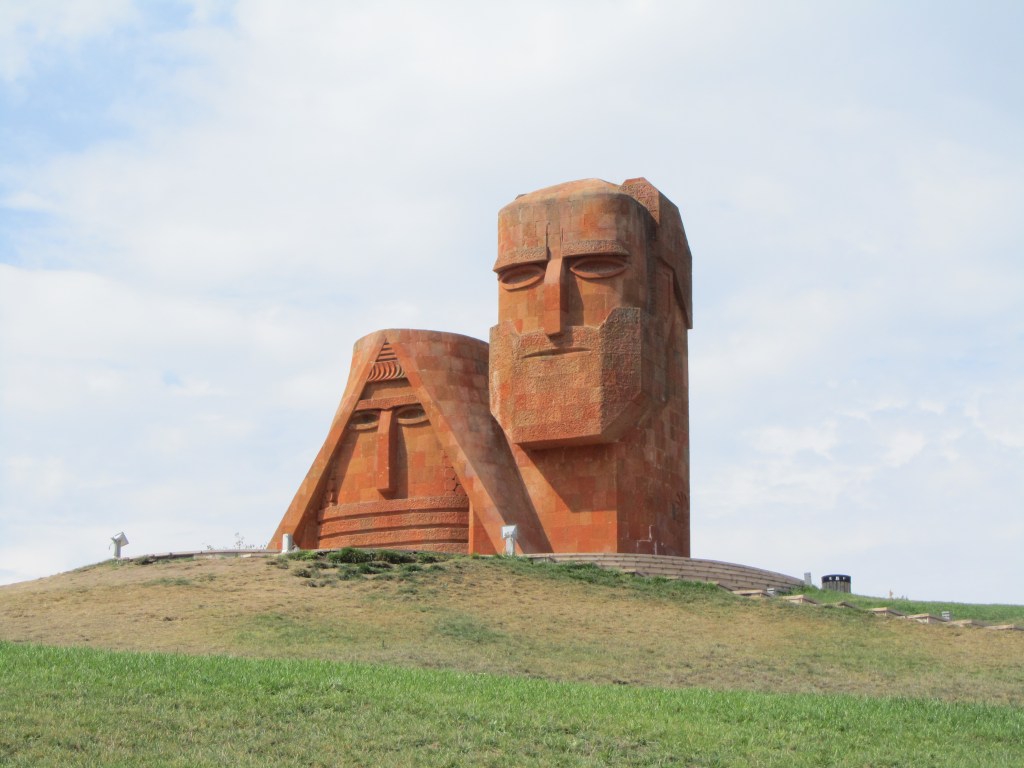
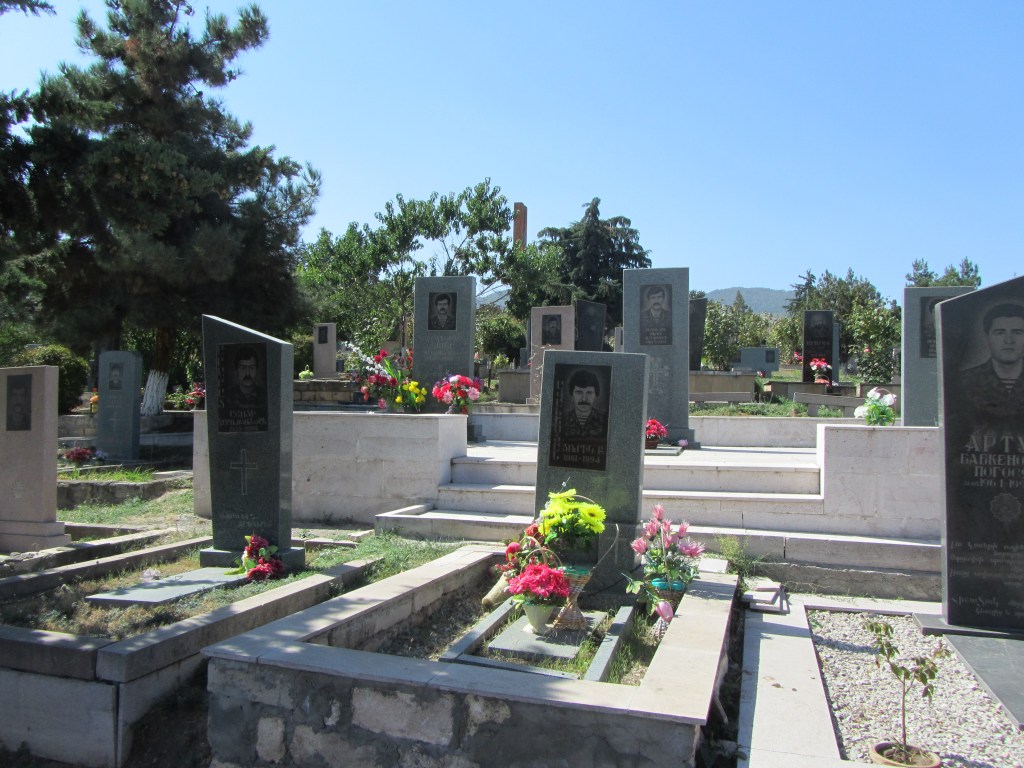
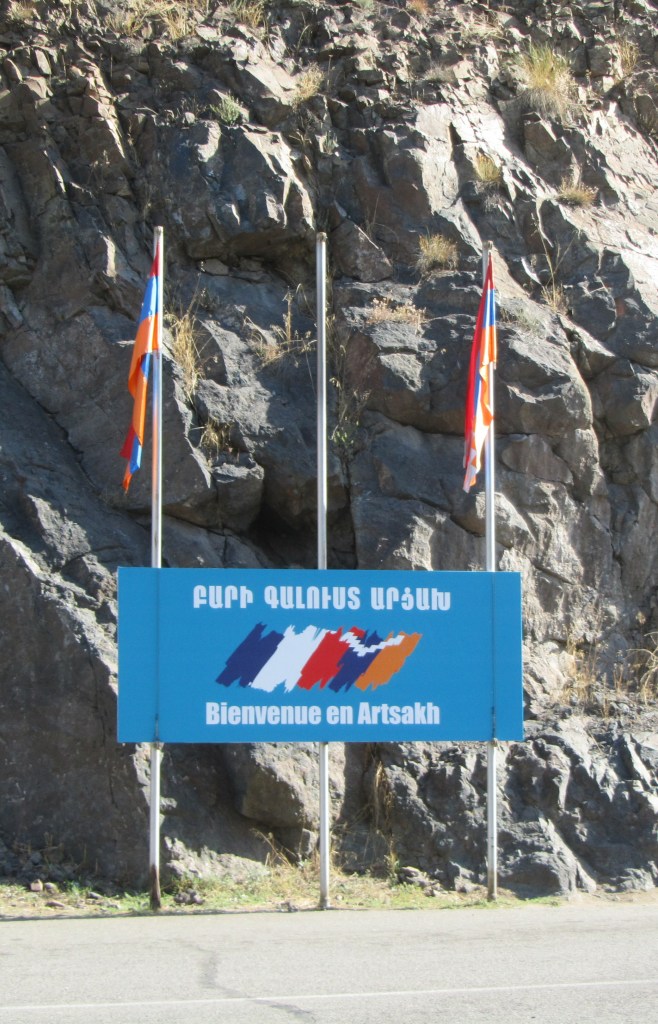
On our second visit we travelled over into Nagorno Karabakh, or Artsakh as it is known to Armenians. The lasting memories for me were to look out over the border into Azerbaijan and see a town abandoned on the border, and also to visit the graveyard in the capital, Stepanakert, and see that all the graves of the soldiers, each with a picture of the man who had been killed, and to note that they were all much the same age as myself. That was very sobering, as was the daily reports of soldiers being wounded or dying in clashes on the boarder that never really ceased.

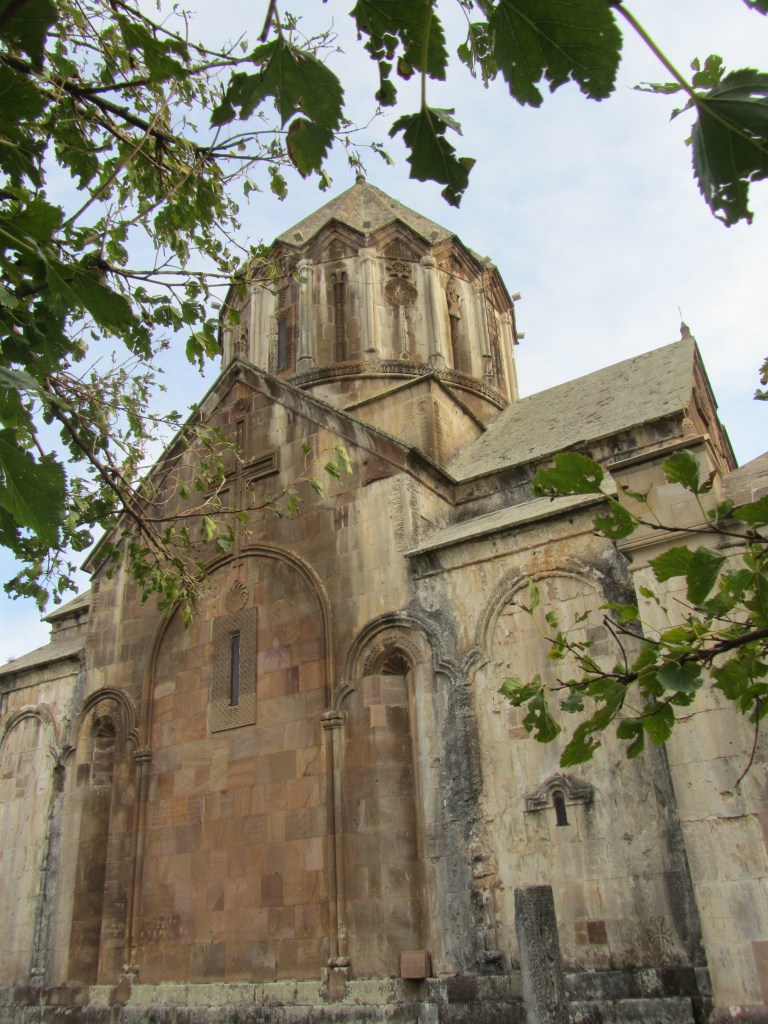
The land, however, is not just a series of villages and farms. We also visited ruins and monasteries that told of many centuries of Armenian history. I am sure that there are other monuments that tell of the histories of others who have lived on that land. Under the USSR there was a mixed population, neither completely Armenian, nor completely Azeri. In the war that followed the demise of the USSR, with Turkey supporting Azeri troops and the Russians backing Armenia, the process of ethnic separation, and ethnic cleansing was begun, each side calling on the doctrine of self determination to claim the land for their own people.

The Armenians predominated in that first conflict and, with the aid of Russian peacekeepers, the Armenian population of Nagorno Karabakh sought to develop their own republic, to practice self-determination. That was only ever going to be possible, however, with the tacit support of Russia. Turkey backed Azerbaijan and armed them in the most recent attacks. And now Russia, partly because of the distraction of Ukraine, partly because Armenian politicians have looked to the west and have had the courage to condemn Russia, but also partly because Russia is seeking to curry favour with Azerbaijan, the support and the protection that had been offered by Russian troops has disappeared.

As so often before in their history, therefore, the Armenians have become the pawns in much larger political movements, and have suffered as a consequence. There have been times in their two to three thousand year history when they were dominant in the area, if only for short periods. However, like all the other peoples of the region their lands have been fought over by larger empires, and despite brief periods of ever hopeful independence and self-determination, they have generally been crushed once again, so leading to their deep-rooted sense of tragedy.

Tragedy, however, does not mean lack of hope. Armenians have spread across the world, and we have attended churches in Manchester, London, Paris, Thessaloniki and New York. They have a strong sense of identity and great hope for the future. Events such as those of the last week or so, however, can do nothing to lift the mood of tragedy and sadness that is such a significant part of their history. Our most recent visit to Armenia coincided with the centenary of the genocide in 1915 and I always recall the text that accompanied the logo for the centenary ‘I remember and demand’.

Reflecting on Excellence

We have just come through the league table season, with the Guardian, the Times and even the new look TEF, each offering their versions of the best universities in the UK. On LinkedIn and elsewhere colleagues are finding the numbers that position their universities in the best light and telling the world that they are ‘number one’ in … whatever it is, or in the top ten, top twenty or whatever it is, in this, that or the other league table.

Swansea University was always very good at league tables, and I leant a great deal from colleagues about how to make the most of the different scores and how to crunch the figures in a way that would give us the best outcomes. League tables are important to student recruitment, and to morale, but it is not entirely clear whether what they are measuring is really ‘excellence’ as so many people assume. It may be one kind of excellence, but it is only that form of excellence that the press, and the marketeers, have chosen to highlight.

Meanwhile the press, and government ministers, also peddle the idea of ‘mediocre teaching’, of a ‘lack of student engagement’, of ‘mickey mouse degrees’ and substandard outcomes. The NSS scores, which underpin many of the league tables, continue to demonstrate that across the sector student satisfaction with both teaching and student engagement remains as high as ever, despite all the changes to the process, with no universities doing dramatically badly. Other surveys do raise questions about the student’s sense of ‘value for money’, aspects of student mental health and other concerns, but it is difficult to turn these into a message about ‘mediocre teaching’ or substandard outcomes. All this talk of failure and mediocrity is simply a useful line to justify the government’s inaction and to appeal to a particular section of the public (whom, it is assumed, are not positive in their view of universities).

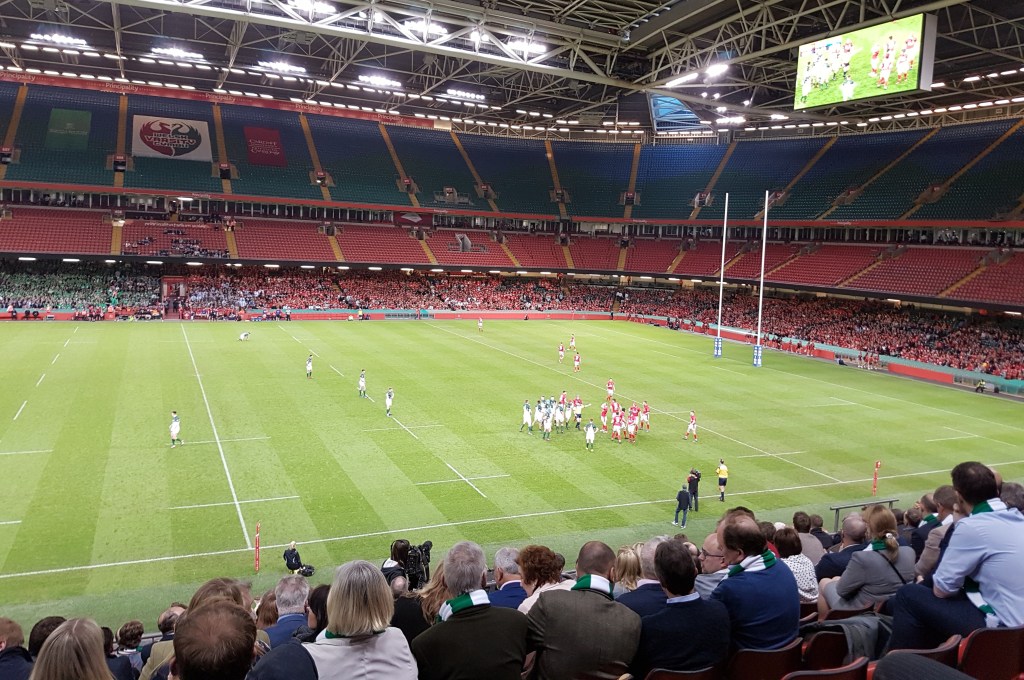
Many of my evenings over the last few months or so, however, have been spent with one eye on the incredible sporting achievements of the summer (not least the rugby, which I never thought I would get really excited about before ending up in Swansea!) and one ear on the Proms, both outstanding examples of excellence in practice. While we can, both as individuals and as nations, take great pride in these achievements and they clearly lift the morale of the community, we do have to recognise that in each case we are talking about a very small elite in terms of the excellence of practice.

I could never aspire to excellence in sport. I would find it very difficult to identify a sport where I would even be considered ‘mediocre’. That does not mean that I do not enjoy watching it and do not recognise excellence when I see it. Whether it is the Women’s football, tennis, the current rugby world cup or whatever else, it has been thrilling to watch people at the very top of their game compete and achieve. I can get caught up in the thrill of losing in the final as much as anybody else.

The Proms are perhaps a slightly different experience, at least for me. I do understand music. I did conduct ensembles and play the french horn up to university and have always appreciated the best performers over a wide range of the classical tradition. The various national youth orchestras that played during the proms were thrilling, raw enthusiasm matched with outstanding talent all working together as a single unit. And, as always with the Proms, there have been several individual performances that have simply taken my breath away. Again, this is excellence, demonstrated by those at the very top of their profession and that can be recognised by all.

Few of us are going to be ‘excellent’ in this sense, at least not in sport or music (although it is clear that we did have some very talented individuals around the campus in Swansea and it was great to see how we could provide the opportunities they needed to do their very best). Throughout my teaching career, my students have always been very generous in their feedback, regularly rating my teaching as excellent and on various occasions nominating me for awards. Teaching is in my blood (many of my wider family are teachers) and there are few pleasures greater than watching students explore new ideas, grasp difficult concept and begin to think critically and creatively for themselves, often outshining me in the development of their ideas. This is something I missed as a senior leader, but the same kind of thrill can often happen as I watched colleagues and those around me develop and achieve in their own particular field.

Research is much more difficult for me. It does not come naturally. Being dyslexic, writing was something that I have had to work very hard to develop. I had many rejections, false starts, poor reviews etc. as I have tried to improve and to see exactly where I was failing. Excellence in research and publication is not something I can ever take for granted and I have had to work very hard to understand enough of the discussion to be part of it, to communicate what it is that I want to say and to be recognised as one of the leading figures in my own field. Reviewers now tend to comment on the clarity and readability of my writing, which I find very rewarding, and I know that my theories and ideas are being taught in Universities from Melbourne to Stockholm, Amsterdam, Edinburgh, New York, Chicago and San Francisco, to name only those courses that I am aware of. I do believe in excellence, therefore, and do believe that we can, and should, all aim to be excellent in our own chosen field.

Perhaps that does mean that there will always be some mediocre teachers within the University, and some mediocre researchers. These people are almost always excellent at other things; be it student engagement, writing research grants, or whatever else it might be. As with sport or music, while we can, and must, recognise the outstanding talent of the few, we must also recognise that that talent does not exist in isolation. The few that we see performing are often part of a wider team or ensemble, but they are also supported and enabled by a much wider team of technical, scientific, medical, coaching, and management staff who make the individual performance possible. Above all, therefore, it was in recognising the role that we all played, the combined effort, that allowed Swansea University to take pride in the excellence of our staff and our students and to celebrate that excellence whenever we saw it and recognised it.

Paintings of the Post Industrial

A couple of weeks ago I was in Coventry and, having a little time to spare, walked round the Cathedral. It is an incredible building and one of the few twentieth century church buildings that works as a complete whole. It is full of art works, most from the same period as the building of the Cathedral, effectively the 1950s. This is a period of British art that I still find fascinating and captivating.

Last year we travelled up to Newcastle under Lyme to visit the Trent Art Gallery who were holding an exhibition of the paintings of Maurice Wade. Wade trained at Burslem School of Art in the 1930s and returned to the Potteries in the 1950s. He was painting in the second half of the twentieth century and had a series of shows at a gallery in London. He had something of a following in his day but would generally have been considered a minor artist. This exhibition, as far as we know, is the only celebration of his work since the 1970s or 80s. It consisted of the collection of the drummer from Orchestral Manoeuvres in the Dark who, it appears, was something of a fan.

Most of Wade’s mature work is basically in black, white, and various shades of grey. This is not an affectation, that is what he sees. These are images of buildings (chapels, factories, canals) in the Potteries area and the view is primarily black and white. There was one image in the exhibition, that I remember, that shows a pottery next to a canal and some of the slag falling towards the bank, giving a streak of orange in the centre of image, what the description suggested was a ‘riot of colour’. Wade was not interested in painting people. It is the buildings and the landscapes that he paints. The sky and the water are left as blank white canvas, so the first impression is one of silhouette, but the joy and skill of Wade as painter is in the subtlety of tone and depth of texture in his painting, requiring the viewer to get up close and to see the stunning detail that exists within the expanse of black and grey. They are beautiful images, if the post-industrial can ever be described as beautiful.

Wade is just one among a series of post-industrial artists that we have been drawn to over the years, with a significant cluster as my time at Swansea was drawing to a close. I came across a print of John Piper’s image of East Swansea in a gallery in London and was blown away. I have always loved Piper (one of my father’s favourite painters) and associate him more with churches and the rural. However, he spent considerable time in Wales, and it is perhaps not too surprising that he painted Swansea, the terrace houses descending to the bay.

More recently we came across Jack Simcock, another artist from Stoke, in an auction catalogue. This was an image of a cottage on the Staffordshire moors (slightly more colour than Wade, but not a lot, somewhere between Wade and the Welsh artist Kyffin Williams). Just before Easter my partner found a wonderful little oil of the Mancunium Way at night, with the lights reflected in the rain, also in an auction catalogue, and a small painting of two Jewish boys, probably on Cheetham Hill, but equally could have been painted in Jerusalem, we do not really know. Finally, at the Trent Art gallery there were other Simcocks, including an image of pigeon shacks, also in black and white and, like Wade, with wonderful layers of texture.

I guess each urban locality has its own painters of industrial and post-industrial landscapes from the 1950s onwards. It is a world that we are just getting to know despite my love of 1950s art, inherited from my father. These local artists were never very well known, beyond the local aficionados and they are not the ‘star’ artists of their generation. However, the images themselves, the post-industrial landscape, has, as I have already said, a stark beauty all of its own, and it is very much part of the life history of my partner and I. He was born in Longton and moved to Manchester, where we met. I was bought up in South Yorkshire and gravitated towards the declining steel mills of Sheffield. We both knew Manchester in the 1980s and 90s, a period of classic post-industrial decline, and then we moved to Birmingham.

Each locality also, clearly, has its own artists and its own images. My partner is inevitably drawn to the Potteries, and we both have great affection for Manchester. I really don’t know who was painting in and around Sheffield, but there must be images of furnaces and chimneys, not to mention ruin and decline, as there is, in fact, in Swansea. We should perhaps know more about the equivalent group of artists around Birmingham and the Black Country. Again, I have to say that I am just not aware of who was painting in this area.

The attraction, however, is not simply because these paintings are post-industrial, or local, or even of a particular period. As the cliché says, I know what I like, although I also like to discover new things, so it is not so much a case of ‘I like what I know’, but the art of the 1950s is a particular passion, along with the music and literature of the same kind of period (although perhaps also going back into the 1920s and 30s). The is the period of Coventry cathedral, not a period noted for its architecture, but one which has produced some strong examples of early post-industrial building as well as painting and other arts.

Learning from the Chaos of 1919-1923

I have been reading Robert Gerwarth’s The Vanquished on the recommendation of a friend. We had been talking about some of the reading I have done recently focused on the Caucuses and Eastern Turkey and how I had come to realise that my knowledge of what was happening in this part of the world following the end of the First World War was practically non-existent. My friend said that his outlook on much of what happened in Eastern Europe, Turkey and the Middle East, and what is currently happening in Ukraine, had been totally transformed by reading Gerwarth’s book.

I am no expert on this period and have no way of testing Gerwarth’s reading of the events. I probably need to read much more about the period to do that effectively. However, much of what he is recounting, in generally objective terms despite the horrors of the events themselves and the many hundreds of thousands of people (mostly civilians) who were killed, seems convincing and while I am sure there may be other interpretations, both of individual events and of the period as a whole, it is the scope and inclusiveness of this account that I find particularly impressive.

There are, of course, many things to learn and many things that have contemporary resonance. What it takes to lose a war. I was surprised by just how close things still were between the allies and the central powers at the end of 1918, the starvation, the despair of the troops, the gruelling horror of years of trench warfare, and yet when it came, the powers capitulated very quickly, but without troops marching across their lands. The two sides in Ukraine are nowhere near this state just now, for all the horror and all the bloodshed. Neither I would guess are ready to give in, and that might mean many more years of war, many more years of suffering.

I had not realised that the doctrine of ‘self-determination’ was effectively an invention of Woodrow Wilson, the US President who attended the peace talks in Paris. This has had a profound impact as an idea, more in the misuse, or in its failure, rather than in any positive consequences. Following the War the minority nationalities of Eastern Europe had their hopes raised and new nations were formed, mostly through the principle of self-determination. However, none of these new states were ethnically or linguistically uniform. Such mixing occurred under the older Empires that it has taken many decades to come to any kind of stability, and the problems still exist. Most of the old enemies, the central powers, were not, however, allowed self-determination and that led to resentments which built into the Second World War. The wider world, however, beyond Europe had self-determination dangled before them, but were not consider fit enough to benefit from it. The allied powers, and their leaders, particularly Wilson, were deeply racist and could not comprehend how non-Europeans could benefit from self-determination. Finally, we are now about to see, when (or if?) Putin falls, the breakup of the Russian Federation, another round of wars and coups and revolutions, initiated by the idea of self-determination

There were, of course, revolutions, coups, and civil wars in the aftermath of the Great War. Many different militias emerged, peasants, ex-soldiers, desperate aristocracies, workers, any body it seems who might have a grudge. As Gerwarth presents it, however, these groups fall into three camps: the Bolsheviks (the radical left who wanted to nationalise everything and set up workers, or peasants councils to grab land and deprive the bourgeoisie of their privilege); the right, usually referred to as ‘whites’ against the Bolshevik ‘reds’, usually nationalist, ex-military and seeking authority and stability at all costs; and finally there are the liberal democrats, but they hardly get a look in during this story. These groups, especially the left and the right, were willing to use excessive brutality and force to impose their will and incredible cruelty accompanied all the revolutions, coups, and take overs, from whichever side. I can see the collapse of the African states post-independence in much of this, the same grabs for power, the same brutality, and in Congo particularly, the same horror for year after year after year.

I was also not entirely conscious of the link between the Bolsheviks and the Jews, with many of the leaders of the soviet revolutions in Russia, Munich, Hungary and elsewhere being prominent Jews. This does not excuse the antisemitic white terrors. They brutally tortured, raped and murdered Jews wherever they could find them, often using the Bolshevik threat as an excuse, but in no way limiting themselves to Bolshevik sympathisers. At one and the same time the Jews were accused of leading a workers’ revolution and masterminding a capitalist sucking dry of the economy. As Gerwarth notes, the only common ground is the internationalism of the Jewish people over against the narrow nationalism of the right-wing militias. The horror for the Jewish people of eastern Europe had been going on for decades (and probably longer) before the Nazi final solution. I knew this, but I don’t think it had really hit home. What is probably equally horrific is that while the Bolshevik threat is probably dead, or at least sleeping for now – although the Taliban regime in Afghanistan has something of about them that seems very familiar – the right wing, popularist, nationalist threat is undoubtedly growing, and with it the horrors of antisemitism and the irrational hatred of all those who are not ‘of us’.

I think the thing that struck me most forcefully, however, was the way in which Gerwarth integrates everything together and shifts the focus of our attention. We are very used to looking at the world from the top right-hand corner of Europe, perhaps seeing France and Germany, possibly Spain, Italy and Scandinavia, but seldom very much beyond that. This is in part a legacy of the cold war, but it is also a tendency to compartmentalise the world – Western Europe, Eastern Europe, Russia, the Middle East, North Africa, the Sahel, etc. – and seeing the problems and issues within each of these, otherwise distinct, spheres. What Gerwarth does so brilliantly is to refocus our attention so much further East, and to reflect on a series of events across both Europe and North Africa which pivot around Turkey and Constantinople. On more than one occasion he suggests that the origins of the First World War occurred in the invasion of Tripoli by the Italians in 1912, followed by the Balkan wars in the next two years, some time before the assassination of the Archduke that is the official spark for the war.

Constantinople and the Ottoman Empire had been declining for many decades, but the First World War sees this Empire collapse, like so many others across Eastern Europe and Russia. What comes next, in Europe and in the Middle East, and even across North Africa, is a consequence of that fall and the disastrous decisions of the victors, in this case Britain and France. We are still living with those consequences. We could even argue, if we draw a horseshoe around the Mediterranean, from Portugal round through Istanbul and Caucasus and on to Morocco and Senegal, that the current coups occurring across the Sahel – Mali, Niger, Chad – are part of this same series of processes. Even the presence of Wagner, supporting these coups, can be traced back to the collapse of all those Empires just over one hundred years ago.

Following the 2015 Consultation on Higher Education and tracking the divides

In November 2015 the UK government published their consultation document, ‘Fulfilling Our Potential, Teaching Excellence, Social Mobility and Student Choice’. The subsequent legislation, the introduction of the Office for Students and the Teaching Excellence Framework (TEF), and the response to this from various relevant bodies in Wales were to have a significant impact on my time at Swansea University. On 19th July 2016 the Higher Education and Research Bill had its second reading in the House of Commons with a government majority of 294 votes to 258. This was three days before parliament broke up for the summer recess, and the fact that the government chose to put this through despite all the issues and concerns following the Brexit vote, says something about the importance that they attached to this legislation at the time. It was finally passed into law in April 2017.

One of the most significant questions at the time was whether Universities in England would be allowed to raise their fees. Jo Johnson had already announced what the maximum fee might be for those who would be entitled to raise their fees (£9250, which assumed a 2.8% inflation rate at the time), and all English Universities raised their fees for 2017/18. In Wales there was no raise in fees, as that had become politically impossible after the election of June 2017, although the original decision was put off till after the publication of the Diamond report, which was published in September 2016.

The Higher Education and Research Bill led to one of the most significant shake ups of the Higher Education sector within England and one that has inevitably had important knock-on effects for Wales, Scotland and Northern Ireland. Looking at the legislation at the time, I identified two areas that I predicted would lead to growing divisions that have proved to be very difficult to bring back together. Any attempt to do so, especially for a potentially new Labour government following the next election could be particularly complex.

The first of these has been the divide between research and teaching. By transforming HEFCE into an Office for Students and by removing all research elements of HEFCE’s previous role and placing them into a new body proposed in the Nurse Review (Research UK), the legislation separated the two arms of the higher education sector. The subsequent restructuring of departmental responsibilities following Theresa May’s reshuffle in June 2017 entrenched this further, with higher education going in with the Department for Education, while responsibility for science and research stayed with the Department for Business, Energy and Industrial Strategy. Jo Johnson, as the minister for Higher Education found himself answerable to two separate Departments.

Despite many further reshuffles, and two or three new governments, this has not changed, and subsequent Secretaries of State have found themselves in a similar, if not worse, state than Jo Johnson. All of us in the sector suffered the same fate, finding our teaching role and our research roles pulling in very different directions under very different scrutiny and expectations. For universities, such as Swansea, that prided themselves on their excellence in both learning and teaching and research, this proved to be particularly difficult.

The other divide that has developed from the legislation is that between the higher education sectors in England, Wales and the other nations. Sitting at the heart of the Higher Education and Research Bill was a mechanism for the expansion of English HEIs and the mechanism for private education providers to attain degree awarding powers and so effectively, to become Universities. Looking at these proposals in detail, and comparing them to the information provided in the Higher Education (Wales) Act 2015, it was immediately apparent that the very definition of what a University is, and the underlying structure of the HE sector in England and Wales were going to diverge considerably. This has only increased in the subsequent years.

I said at the time that ‘the danger is that English and Welsh higher education (and probably post-compulsory education as a whole) will begin to look very different. This is something that we will have to watch very carefully indeed’. This has, of course, happened and since the passing of the Tertiary Education and Research Bill (Wales) Act in September 2022 this divide has become even more embedded. This has not been an unmitigated disaster. Those of us who were in the Welsh sector were very pleased not to be subject to the Office for Students and to retain the QAA as the recognised quality body. However, the divergence in fees has undoubtedly had a very detrimental effect on the HEIs in Wales, especially when compared to their English compatriots.

The real question, however, is how far these divides, originating in the 2017 act are baked in. Is there an argument for trying to turn them around and work more towards bringing research and teaching back into a single framework, or to bring the various national HE sectors across the UK back into alignment? On the first question, I have no doubt that most of those in the sector would like to see more integration of teaching and research, especially at the level of governance at the national level. It has been said by several commentators that if the UK really wants to become a hi-tech superpower, then it is essential to bring these two functions back together and for higher education to be the responsibility of one government department.

The question of the re-alignment of the different national HE sectors, however, is not so clear. Simply bringing Wales and England back towards a common structure or common goals probably does not make sense without also considering Scotland and Northern Ireland. There is perhaps more commonality today among the Celtic nations, at least in values and approach, than any of them have with England. I would not necessarily want to see that disrupted. Likewise, the fees question is much larger than simply realigning England and Wales, although that might be a start. More significantly, however, at least from my limited perspective, is the development in Wales of a post-sixteen sector. This is a radical and positive move and there will undoubtedly be elements of what Wales is pioneering in this area that the other nations will want to learn from. If there is a Labour administration after the next election then I can see this gaining pace, and for this to be just one of a number of initiatives in Wales that might be transferred to England, so bringing a greater alignment once again, but in a very new and distinctive way.

Aspirations

In a paper that I read recently on the im-materiality of religion, the author chose to use the word ‘aspiration’ as one of those elements that she described as an immaterial aspect of religion. The authors, Marian Burkhart and Maria Westendorp, were arguing that scholars of urban religion had become too fixated on the material manifestations of religion within the urban environment. By looking at the lives of two Christian women involved in the umbrella movement in Hong Kong, they suggested that it is also important to look at immaterial elements, and among those they chose to identify ‘aspirations’. Religion, it appears gives these women aspirations, both for their own lives, but perhaps more importantly for the city itself.

I think I was most struck by the choice of word. I would talk of ‘hopes’, or of ‘ambitions’, I am not sure that ‘aspirations’ is a word that I would have thought of in the context. However, having used the word, this paper set me thinking. Is there something that ‘aspirations’ might offer that some of the other words that we could use do not?

In particular, I began to think about students going to university and the various discourses that currently exist around the expectations, hopes and ambitions that students have as they start on their journey. The government, for example, and many others within our society, tend to assume that the purpose of going to university is to get a good job and to earn money. The assumption is that students are ambitious, they want the very best for themselves and they can calculate the value of attending university, setting this against the debts that they will incur, and, taking all that into account, plan for their future, their ambition.

At another level there is also a growing sense of entitlement. This derives from the idea that we have commercialised university so much, set a price on the privilege of learning, that students come to university with expectations of success. They feel entitled, not just to outstanding teaching and world leading student support, but to the result that they expect to achieve. I have written elsewhere about the way in which expectations have changed, from my own day, way back in the 1980s, when I felt I was lucky just to get the chance to attend university, to today when students turn up expecting to achieve a first class degree, or at least a 2:1, because that is what they are paying for.

And to turn this around once again, there are also narratives which tell us how unprepared students are for university. The pandemic, the disruption to education, the levels of concern about mental health among young people, all mean that students come to university not believing that they can achieve, not knowing how to turn things around, to gain resilience, or even to survive. Such students need all the support we can offer simply to remain and to focus on their learning, let alone worrying about their expectations for the future, if any such future even exists as the world overheats and all the jobs are taken by AI chatbots.

There are so many conflicting messages out there, different narratives that not only those in universities need to manage, but that students also need to negotiate and find their way around. It is obvious that many students may well switch between these narratives, and many more, only settling on any one within the specific context in which they must identify what it is that they expect, assume, or desire from university.

Is this a context in which to talk about ‘aspirations’ might help us to cut through all the noise? Somehow the word itself seems softer than either ‘expectations’ or ‘ambitions’. We may be ambitious for a good job, high earnings, fame and fortune. We might expect, either everything on a plate, or complete disaster. There is something in the words themselves that lead us to associate them with a particular kind of outcome, and in each case something very precise and very concrete. ‘Aspiration’ raises other kinds of opportunity. The fact that the authors in the original paper use it in a religious context gives some hint to this. We might want to say, for example, that we are ambitious for a good job and high salary, but we aspire to a good life, to helping others, to giving something back to the world or to society. Aspiration almost demands something positive, something more abstract, something that we can, perhaps, all share.

This is perhaps pushing the argument too far. We can all aspire to a good job and a high salary, but even saying that suggests to me that the way we might go about achieving that would be different from the methods we would use if we simply said we were ambitious. Ambitions are selfish? Aspirations are charitable? Perhaps, or perhaps not. This may just be my own associations. However, I do think there is something in what I am trying to get at here.

The real question, therefore, is to ask what starts to happen if we begin to talk to students about their aspirations, whether in applying to university, in coming to university, or for what it is that they want out of university and for the rest of their lives. If we can only ask students to think carefully about what it is that they aspire to, and why, then we might be able to have a very different kind of conversation. We might be able to change the narrative, to focus on more than simply getting a good grade, or even surviving three years. It has something to do with confidence, something much more personal than expectations or ambitions, something that talks of values as well as instrumentality. It is probably something that all good employability units do already, as will many academic tutors, without ever naming it as a particular approach. I may be being romantic. It is just that reading that paper, about something entirely different, suddenly got me thinking, and, you never know, there may just be something in it.

Snow White in the Age of Social Media

Snow White acts as something of leitmotif throughout my current book on the nature and use of stories in religion. In each chapter I provide a different analysis of the tale and a different perspective or way of telling the story. In the chapter on ‘Function’ (which begins with the theories of Malinowski) I suggest that one of the functions of fairy tales is to provide an emotional journey, following the hero through a series of trials and torments leading to the happy ever after. Snow White is built around a series of crises, each building on the last, in which the emotional tension rises, only to be released before building to the next crisis and a new predicament for the young hero. I suggest that this is the same kind of construction that was later used by Dickens and his contemporaries in publishing novels in parts, each with cliff hanger at the end forcing the reader to buy the next part, of contemporary multi-part television dramas, with the same use of the cliff hanger endings to draw us into binge watching the whole series in one go. I suggest that Snow White would make an excellent gritty contemporary drama over six episodes, but I don’t have the space in the book to outline what that might look like. This is my re-imagined story: –

Episode One: Mirror

Rose, a fifteen-year-old girl, is one of two adopted children of a self-focused celebrity and social-media influencer. Prince, the older brother, maybe around twenty, is constantly rowing with his mother as she seems more interested in her own media presence than any of her children (who are just part of this image). Rose is a sassy self-opinionated young woman, and we see her out with friends, playing with a choker and heart pendent, and spending long periods of time on social media with her online friends. The mother wants both the children to attend parties and humiliates Rose because she is not traditionally attractive. The mother gets angry at some other celebrity who appears to be eclipsing her on social media and seeks the help of Al, her publicity guru, to take the rival down. This shows her ruthlessness and lack of concern for others. Towards the end of the episode, the mother notices that her daughter has more ‘likes’ than her, despite not conforming to her idea of beauty and behaviour. Rose’s posts are based on ‘clean living’ and condemning the values of her mother and her lifestyle. The episode ends with Rose reading a long rant on her tablet in which her mother is threatening to tear her to shreds and even to kill her.

Episode Two: Heart

A party is getting underway, hosted by the mother. She is insisting that Rose is present, although she is very reluctant and wants to be with her own friends. The Party is attended by a whole series of celebrities, all of whom are getting off their heads with drink and drugs. The mother instructs Al to get Rose drunk or stoned, but she is not touching either drink or drugs. Al spikes her drinks and slowly she begins to lose control, and, at the mother’s insistence, she is plied with drugs. The mother tells Al to take Rose into town, to photograph her in compromising positions, and to upload these onto her social media sites. The next day police arrive at the door, only Prince is around having come back early in the morning to find the remnants of the party. The Police give him the choker, a coat and boots and Rose’s phone. They say they found them by a bridge over the river. Prince screams through the house, waking his mother and asking what she has done. She pretends to be shocked, blames Al and then collapses again. Prince finds Al in a seedy bar in town, distraught. He says that he cannot go back because he has killed Rose and cannot be forgiven. He just wants to die.

Episode Three: Forest

Rose is walking, dishevelled and dazed along the back streets of the town. A Police car stops but Rose swears at them, and the officers choose to drive on. Rose collapses and falls in a doorway. A street preacher passes, tries to raise her and then goes to get help. Once he has gone, Rose struggles up and starts to stagger down the street. She is picked up by a man in a beaten up, but once expensive, car. He can get nothing out of her and takes her back to a run-down house where there are other men and girls, all illegal immigrants. He clearly runs some kind of trafficking outfit and is constantly arguing with the other men. The other girls are more street wise and can give as good as they get, although there is a constant air of violence and menace. When Rose comes round, she cannot, or pretends not to, remember her name, and is initially treated well by the other girls. However, after a few days, one of the girls asks why this new girl (called Snow because of the remnants of drugs down her front when she was brought in) is not ‘earning her keep’, there is an almighty row and the bloke who picked her up, Forest, insists that she is not that type of girl. When he is away for a couple of days, and the guy in charge gets a call. He decides it’s time for Rose/Snow to work (it is never stated what the ‘work’ is and we are left to guess), and dresses her in white before taking her out to the car only to see Forest standing in the road looking daggers at him.

Episode Four: Fairest

Prince has been searching for any sign of his sister. He demands that the police officer at the station tell him whether any bodies have been found, they have not, and why they are not out there looking for her. The officer is dismissive, it is clearly a case of suicide. Prince goes back to his flat. Al is there, drunk and in despair. He cannot say whether he killed Rose, or whether she jumped, or whether he imagined the whole thing, he is beginning to doubt his sanity and blames the mother, who is now all-over social media as if nothing had happened. Prince is also touring the bars, asking for any news. At one, on the edge of the district, he meets the bloke from the traffickers clearly the worse for wear. Prince shows him the photo and bloke says that he can get him a girl that looks just like her, but it will cost. The next day Prince comes back, and the bloke comes in with a different girl, he says this one will have to do, the other is worth more than he could afford, and then leaves. Prince asks the girl about Rose and shows her the photo. The girl recognises her and says how the boss is protecting her, she cannot leave the house, and does all the cleaning, but she is also not being asked to work. She thinks her boss is keeping her for himself. Prince asks if the girl would be prepared to smuggle a phone to Rose and at first the girl is reluctant, but she is persuaded. The episode ends with the mother scrolling through her phone and suddenly seeing an image of her daughter looking fresh faced with no further comment. She screams.

Episode Five: Choker

The mother is waiting in an upmarket hotel, scrolling on her phone and vaping. She is joined by Forest looking very suspicious. She shows him the picture and asks if he knows the girl. Forest denies it, but the mother persists. She says that she represents a very important client who would pay handsomely for time with this girl. Forest looks again at the picture and asks where the mother got it and why she thought it had anything to do with him. She says he was not easy to track down, but the image is trending on social media and gaining lots of attention. Forest is now nervous and asks what the arrangements might be. The mother says she wants the image taken down and that she wants to meet with the girl to ‘prepare’ her, she will make it more than worth his while. Later, at the house, all the other residents have been sent out and only Forest and Rose are present. Forest also leaves and says that he is expecting a visitor, Rose is to entertain her till he returns. The mother arrives, veiled, and Rose does not recognise her, or pretends that she does not recognise her. They talk and the mother says that she should smarten herself up. She says that she has some things in her bag that would make her look pretty. Rose is reluctant but is talked into it by her mother. Standing behind Rose, her mother removes her veil and Rose recognises her in the mirror although she says nothing. The mother combs her hair, applies make up etc. and then takes the choker out of the bag. Rose says that the choker was given to her by her birth mother, and the stepmother smiles. Rose lets her stepmother put the choker on and makes some comments about social media, taunting her stepmother, who proceeds to tighten the choker around her neck.

Episode Six: Glass

Forest is pacing up and down a hospital waiting room with glass walls and large window. Rose is not dead, but she is unconscious. Forest is making up stories about how she choked on a piece of apple. The doctors want to call the police, they are not convinced by the explanation. Forest is getting scarred and is about to get violent when Prince arrives, the other girl has called him. He goes for Forest who stumbles and runs for the door. Prince is sitting by the bedside when his stepmother walks in, she says she has come to look after her daughter, how relieved she is that Rose is alive, etc. Prince tells her to leave and the mother throws insults at him, accusing him of always lusting after his sister. Prince is angry and threatens his mother. She leaves, throwing down some grapes that she said she had brought for Rose, insisting that Prince makes sure Rose gets them when she wakes up. Somewhat later Al comes in, sobering up and wanting to seek Rose’s forgiveness. She is still in a coma, or is pretending to be, and he sits with Prince absentmindedly eating the grapes. He suddenly jumps up and rushes out with stomach pains and Prince urgently calls a doctor, saying the grapes must have been poisoned. The show ends with Prince giving a statement to the police, saying how he believes that his sister was trafficked and strangled by Forest and that his mother tried to poison her. The police look very sceptical and say that they could only corroborate this if Rose wakes up, all the evidence is circumstantial, and the show ends with a police guard on the door of Rose’s room in the hospital.

Not a satisfactory ending, I know, but then neither is the happy ever after of the original story! I also want to make Rose’s complicity, or direction, of the action somewhat ambiguous, she cannot be a passive ‘victim’. Likewise, we should never be sure if Forest is a trafficker running a prostitution racket, or a legitimate asylum seeker, and that others in the house are taking advantage of him. I would want to leave a certain level of moral ambiguity.

Walking Across Paris

Walking in Paris is a very different experience from walking in London. Above all there is less obvious difference and contrast within Paris, or at least within the centre of Paris. Normally, I would travel by Metro, but on my last trip, to visit the exhibition of a sale of some of Hélène Leloup’s collection of African, or more particularly Dogon, art, I had arranged the flights so that I would effectively have two full days in the city, and the exhibition (along with others at Christie’s and the Paris auction houses at Drouot) would not take all that time. What is more, until the last hour or so of the second day it was beautiful weather and ideal for just a gentle wander through the streets, not exactly springtime, but pleasant enough all the same.

When we usually visit Paris, it is to attend Parcours des Mondes (the annual exhibition of non-European art held among the galleries of Saint Germain des Prés in September each year) and we stay in a hotel in the Latin Quarter. On this occasion, because of the late decision to go and see the exhibition (I really couldn’t miss it given Leloup’s central position in the writing on the Dogon) our usual hotel was full, and I booked into a hotel not far from Sotherby’s who were hosting the sale, on the Boulevard Haussmann.

However, from the airport I got the RER down to St Michel and toured the galleries of St Germain before heading across the river, through the Jardin des Tuileries and on to the Rue Saint Honoré, at the end of which, opposite the Palais de l’Élysée, Sotherby’s has it’s Paris offices. Then, after lunch at a street corner café, it was on to the hotel (and some shopping at Printemps). The following day I explored the area around the hotel, the Parc Monceau, a couple of musées on its edge, and then down to Christie’s just off the Champs Élysée, back to Sotherby’s for a second look, and on, via the Madelaine to Rue Drouot, some exploring of that area, and back to the hotel via the Musée Gustave Moreau and the Eglise de la Saint Trinité, before walking from the hotel, down the length of the Rue Saint Honoré to Les Halles and the train back to the airport (it was on this last stretch that the heavens opened and I had to shelter in the perfume and candle shop Diptyque).

Wherever you walk in this central area of Paris you are surrounded by multi story stone houses, of differing styles, but all of a similar size and grandeur. Of course, what happens at ground level does vary, especially in shopping areas or in the occasional street set aside to cater for tourists and filled with cafés and other food outlets. Before reading Edmund de Waal’s The Hare with the Amber Eyes I had assumed, without really thinking, that these were all either offices or flats. It has not occurred to me that many were single mansions owned by individual families. Perhaps in some parts that was never the case. It was in the area around the Parc Monceau, where I was wandering on the second morning, that the house that is mentioned in de Waal’s book is situated, and it was clearly a place where numerous wealthy families lived. Three of the mansions are now museums and I visited two on this trip (we had been to the third on our last visit). This gives a very different insight into what otherwise seem very impersonal blocks of stone clad buildings, each fronting directly onto the street with no gardens to speak of (but just look up, and the joy of seeing large plants, including lemon trees, growing on the balconies above gives a splash of colour even to the most monochrome of these streets).

It is, however, at street level, and perhaps with the people, that the real variety is seen. The galleries and cafés of Saint Germain des Prés, the designer outlets, and designer people, of the Rue Saint Honoré and the much more earthy and human communities around Rue Drouot, leading up to Montmartre. Equally significant are the views. Haussmann, in designing the street plan, was very keen to encourage long streets, at different angles, that lead to vistas and points of view across the city. To turn a corner and then to see the road laid out, often with a monument or church in the far distance, is one of the great pleasures of walking around Paris.

Paris is a city of revolutions and of riots, as we have seen only to clearly in recent weeks. The divisions of wealth, of race, of society are as strong as in any city anywhere in the world. They are just not so obvious on the streets in the centre, except at times of trouble and protest. Paris has always been for me, despite all this, a very human city. Perhaps the riots, the violence, the open expressions of naked emotion, are part of that humanity. There is nothing that is false, or in the English sense ‘polite’ about Paris (although I have always found the people welcoming and seldom rude, as their reputation so often suggests). The scale is also not immediately human, but the repetitions, the long-repeated avenues, the stone clad buildings, all subtle variations of each other, are, in some strange way, human. It is also the cafés, tables and chairs on practically every corner, the simplicity of the fare, the buzz of people sitting, stopping, eating, drinking, that is human. I feel comfortable, relaxed, able to merge into the background. It is a real pleasure to walk around the city and watch its people going about their business.

Needless to say, I did not buy anything at any of the auctions. The prices were far too high for me. I simply wanted to go and to see what was there, and how they were presented. It is, of course, possible to do this online, but that is not the same. To be able to look at the objects themselves, objects that had been handled by Hélène Leloup, objects that had been made, and used, by the Dogon, was an incredible privilege, and well worth taking a couple of days in Paris.

On Reading Dalrymple, Christians and the Middle East

I have just finished reading William Dalrymple’s From the Holy Mountain. I have to say that it was one of the most depressing books that I have read in a long time. The book outlines Dalrymple’s journey from Mount Athos through Turkey, Syria, Lebanon, Israel and Egypt to the Coptic necropolis of Bagawat in the southern Egyptian desert. Dalrymple is drawing inspiration from The Spiritual Meadow of John Moschos. This was written in the late sixth century and early seventh century, at the height of the Byzantine Empire, and just before the rapid growth of Islam. It is, among other things, an account of Moschos’ travels and his visits to various monasteries across the region. It is these monasteries that Dalrymple sets out to visit.

What is very clear, however, is that, apart from Athos, where Dalrymple starts his journey, the Christian communities he visits are under existential threat and persecution. The people, unable to survive in their native lands, are rapidly emigrating to the US, Canada and Sweden, among other places. The ancient Christian communities across the Middle East are dying out. Dalrymple travelled in the early 1990s, and he consistently predicts that within twenty years there will be no Christians left in the countries that he visited.

Dalrymple recounts many stories of horror, of violence, of naked persecution and of despair. What is interesting, however, is that in each country the troubles faced by the Christians come from different sources, whether it is from nationalists (primarily Kurds, but also Turks) in southern Turkey, Jewish settlers in Israel, or Islamic extremists in Egypt. In the Lebanon it is even other Christians who are the primary cause of the persecution and violence. Only in Syria are the Christian communities relatively safe and thriving, although we all know only too well what has happened there in more recent years. Twenty years on, now thirty years on, some, very small, Christian communities are still struggling to survive, but I would doubt whether many of the monasteries that Dalrymple visited are still open, even in the very limited way they were in the 1990s.

It is not just the contemporary oppression of the Christian communities that Dalrymple articulates. His narrative puts this into an historical context and demonstrates, across the region, how the downfall of the Ottoman Empire (under which, for five centuries or so, the Christians had been tolerated and allowed to live and worship in relative freedom), and the outcomes of the First World War, colonialism and the establishment of the State of Israel, with all the errors and mistakes that were made by Britain and France, and others, across the region, it was always the Christians who suffered and, as nationalisms grew, it was the Christians who were expelled, or destroyed in one genocidal massacre or another.

While those perpetuating the horrors that Dalrymple relates are almost always local, he clearly places the blame firmly on the Western powers and their actions, both in the past and in the present. The drive to ethnic unity, nationalism, religious purity, or whatever it might be, has led to Christian communities being forcibly expelled from the lands in which Christianity had its birth, but that drive has its roots in the actions, and decisions of Britain and France and other Western nations. All this was happening, and continues to happen, with the full knowledge of Western governments, but with hardly any significant comment or condemnation on their behalf.

One of the points that Dalrymple wishes to emphasise is the common origins, in a local Semitic culture, of Christianity, Islam and Judaism. Over and over again Dalrymple compares a particular Syriac or Coptic Christian practice with what we usually associate as Islamic practice, showing the very close similarities between the two. The keeping of the times of prayer, fasting, the actions of prayer, the call to prayer and so on. It is the common heritage that Dalrymple highlights, and it is this, in his view, that makes the current oppression of the Christian communities, and their expulsion from their native lands, all the more devastating. In many places Christian and Muslims shared common traditions, healing rites associated with particular shrines for example, and common spaces where both Muslims and Christians worshiped, together, but in their own way.

Added to this is the way in which, in Turkey and in Israel particularly, it is not just the communities that are being oppressed. The material remains, the monasteries, the churches and other monuments, are also being systematically obliterated. It is the memory that is being destroyed, all evidence that there ever was a strong and thriving Christian community in these places. This a cultural vandalism that Dalrymple finds to be particularly devastating and one that has the potential to destroy much of the cultural remains and art of the late Byzantine period across the region. It did not stop in the 1990s of course. The destruction, of both communities and peoples, has continued with the civil wars in Iraq and Syria (still a small beacon of hope in Dalrymple’s book) and the continued oppression of minority religions in Iran. The Christian communities of the whole region are now, very obviously, hanging on by a thread. History and heritage are being lost and the people are moving away in ever increasing numbers.

Ironically, I was reading Dalrymple’s book as I was also reading the Book of Joshua for my daily bible reading. Joshua tells the story of the people of Israel taking possession of the land that God had promised them. What becomes very telling, particularly in the light of Dalrymple’s text, is the constant refrain, throughout Joshua, of God telling the people to destroy each city and all its people, not one is to be saved, not even the women or children. God is demanding total extinction, absolute ethnic cleansing. It is against this background, this ancient ideology (not just for the people of Israel, but for all peoples of the region) that I was reading about the destruction of the Christian communities. Has anything significant changed in the three or four thousand years between these texts? I fear not, and that it perhaps the most depressing element of all.