I had the honour recently of attending a roundtable conference hosted by an ex-PhD student at the Buddahpadipa temple in Wimbledon in recognition of his recent appointment as Abbot. It was a very inspiring event in which monks alongside lay members and visitors to the temple were all asked to reflect on four questions that had been prepared in advance. There was no sense of experts, or those with more important things to say, and all those who wished were able to contribute their own thoughts on each of the questions under consideration. There was clearly a Buddhist flavour to the whole event, but participants brought contributions from their own reading of Buddhist scriptures, stories and reflections from their own experience, and reflections from their worlds of work as therapists, teachers, students or whatever.

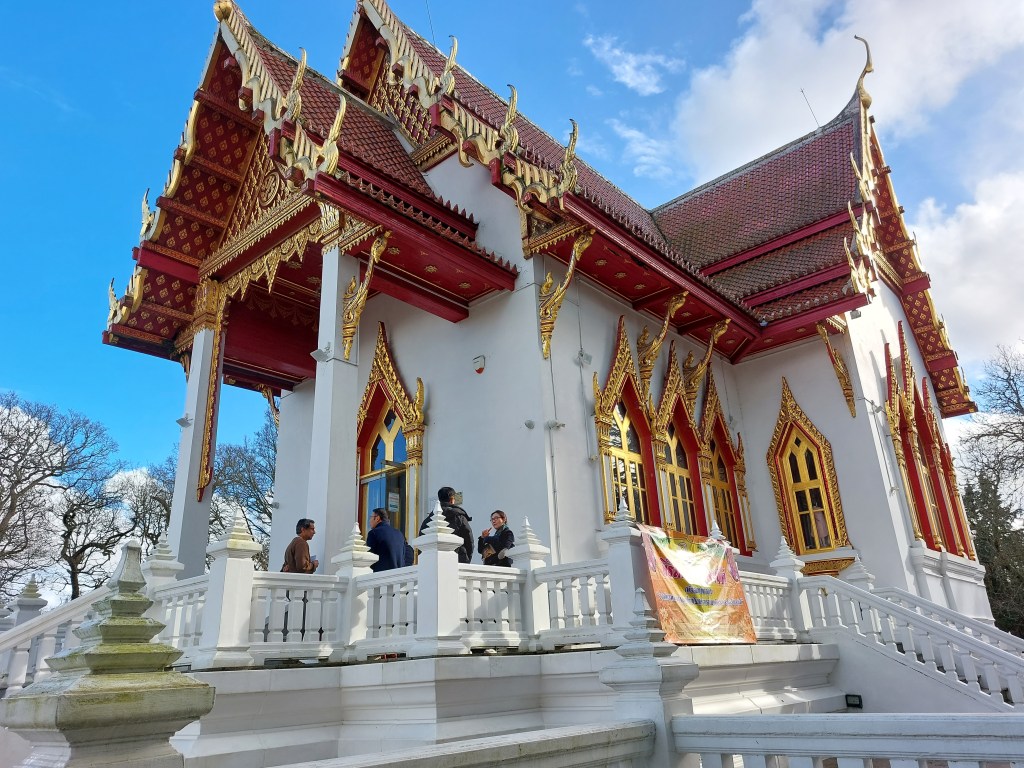
It was not even that the monks were given a privileged position. All participants were given due respect. Even a four year old boy who told us that he thought the temple was beautiful outside, that the temple was beautiful inside and that he liked the people who gathered at the temple. The more informed, or well read, members of the community were listened to, but so were those who were new to Buddhism, or had simply accompanied another person and had not intended to contribute at all. I was asked to add my own thoughts and reflections, but as one who had supported the Abbot in his studies, not as a particular expert, and my own Catholic position was respected alongside that of all the others in the room. This was an unusual, and very special, event with an openness that is difficult to find in today’s world.
The questions ranged around responding to criticism, forgiveness, justice, detachment and the purity of mind, but it was the conversations and contributions that followed that were more interesting than the questions themselves. However, across all the contributions the theme of the self, of the I, and of the relationship of the self to others and to the world were a constant thread. One of the statements that remained with me throughout the session was the observation that it is not selfish to manage the self, to find inner purity, before reaching out to help others.
I have always lived by a position, inherited from my Grandfather, a priest of the Church of England, that every individual is unique and we should respond to each with respect and love, whoever they are, or whatever they bring. This is linked in my own thinking to the statement Margaret Thatcher made to the Methodist Conference back in the 1980s where she said that there is no such thing as society, only individuals and families. I am not in full agreement with that principle, but I am sure that we often underplay the importance of the uniqueness of the individual, or of the self. However, I would always claim that the self that matters in not myself, but the self of the other. This I would link to a deep Christian tradition of selflessness and a reaching out to the other that sees its roots in the actions and words of Jesus in the Gospels.
To suggest, therefore, that we should concentrate on our own self first, even if this is as part of preparing us to reach out to others, is something that I initially found difficult. However, the statement does make sense, and does reflect very clearly what I have always done, even if it is not expressed in the values that I say that I live by. In inter-religious dialogue it is well accepted that we cannot reach out to those of other religious traditions unless we are confident in our own position, however open we might be to change. There is something of common sense in this proposition, but it did get me thinking more broadly around the questions of self, myself and, what the Buddhists present suggested was something subtly different, I.
The first question we addressed had to do with responding to the opinions of others, especially when they were offensive, and hence about forgiveness. The standard answer to this was to stress the importance of detachment and to recognise the criticism of others, especially offensive criticism, as a problem in the other, rather than the self, not to take offence and effectively to rise above it. The responses were more subtle and complex than this, but that was the essence. In the light of this, however, and in reflecting on the question of the self, the I, and the other that I have already addressed, I could not help thinking, as I drove home, what all this has to say to contemporary identity politics and the ease with which so many in our society give, and take, offence, especially in the wake of social media.
Identity politics is essentially about taking pride in our identity when others discriminate against us. It inevitably places the self first, but also latches on to specific elements of the self that can be categorised and treated as a social type. Even if we acknowledge the importance of intersectionality, to claim the importance of our identities, and to expect others to recognise that as a social, or even human, right, places the self in a very difficult position, especially in traditions that ask us to deny our ‘selves’. By highlighting, celebrating and fighting for my right to be ‘gay’, ‘dyslexic’ or whatever, then it is possible to argue that I am standing alongside all those others who claim that identity and I am not doing this for ‘myself’ but for all those who are oppressed, discriminated against or abused because they are ‘gay’, ‘dyslexic’ or whatever. To claim the identity, however, as the most significant fact about myself is, I would suggest, placing self above the other, and going beyond the position that I would want to hold for myself.
Does the suggestion, however, that we need to be selfish about sorting out our own self, and being comfortable in that self, before we can help others, make any difference to this initial position? There is certainly some potential here. It is important to be comfortable in one’s own skin and confident of one’s own ‘self’ before being of any real use to others. But that is only half the story. If I take what I heard to be the distinction between the ‘self’ and the ‘I’ that was being proposed, then the self is that which is eternal, fundamental, and travels from life to life towards enlightenment. The ’I’ is the current being, the impermanent, the transitory, perhaps even the illusory, and it is the ‘I’ that is ‘gay’, ‘dyslexic’ or whatever. In this view, one’s identity (as defined by identity politics) is part of that which we need to become detached from, not something to celebrate for itself. Only in this way can we rise above the offence that is inherent in the culture wars and other discourses on identity.
Perhaps, or perhaps not?!? I am not sure that I am really making very much sense of this, and inevitably, any such reflection leads to masses of further questions, to contradictions and to intellectual dead ends, as well as to moments of enlightenment. It is this, for me at least, that makes events such as this roundtable conference so inspiring and why I would always say that we do not have nearly enough of these events, events at which people can simply share their thoughts and reflections on the bigger issues without any fear of offence and with the knowledge that their views, however unusual, will be respected.


Totally……. totally agree with that sentiment and always I do try and live by it
LikeLike